In 2026, the mantra "you build it, you run it" is undergoing a massive reality check. While DevOps broke down silos, it inadvertently buried developers under a mountain of infrastructure "toil." Large-scale organizations are now pivoting toward the internal developer platform (IDP) to reclaim developer velocity. By abstracting away the complexities of the underlying infrastructure, an IDP allows engineers to focus on code while the platform handles the heavy lifting of environment provisioning and maintenance.
1. Understanding the IDP Meaning: Beyond the DevOps Hype
To appreciate this shift, we must first clarify the idp meaning. An internal developer platform is a self-service layer that sits between developers and the underlying technologies (like Kubernetes, Cloud providers, and CI/CD runners).
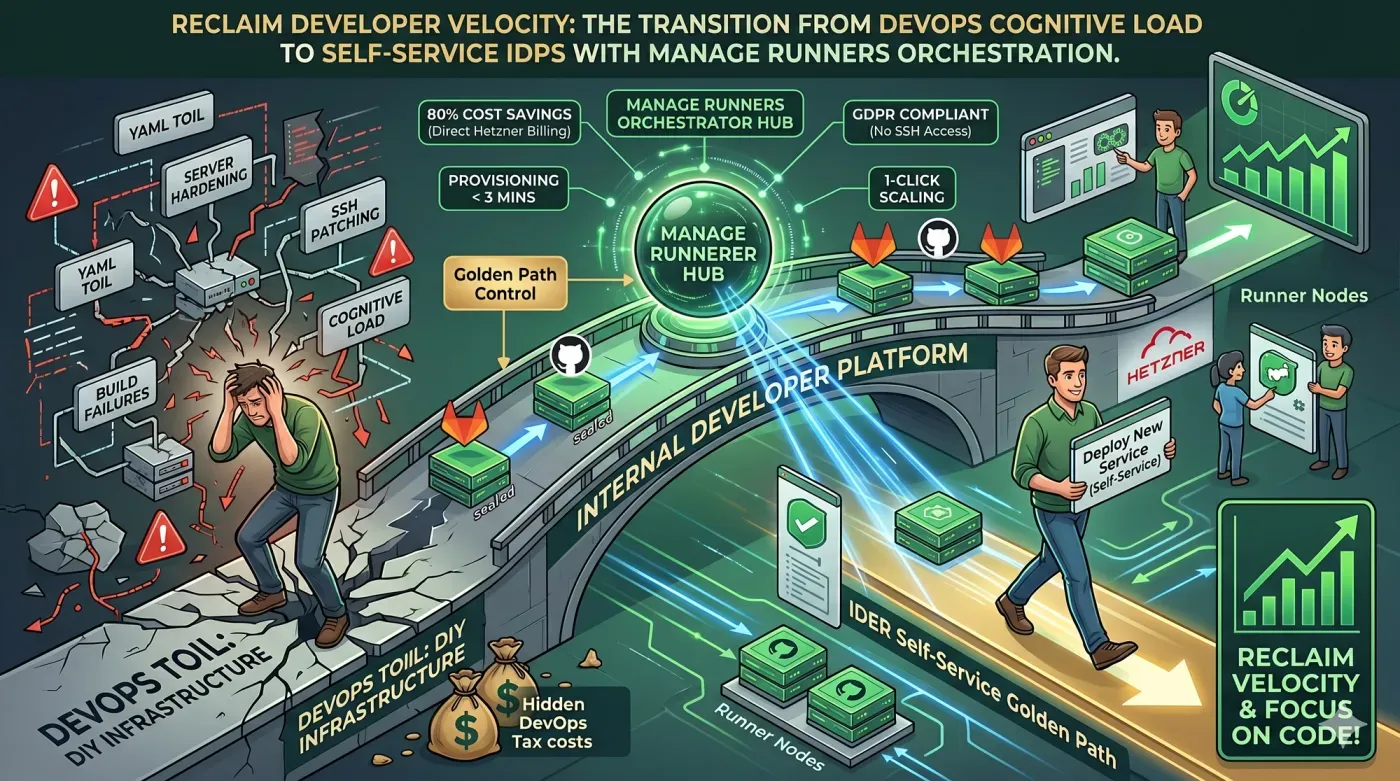
Unlike traditional DevOps, where developers often have to manually configure their own resources, an IDP provides a "Golden Path" a standardized, pre-approved way to deploy and manage services. This reduces "cognitive load," ensuring that a developer doesn't need to be a senior SRE just to trigger a pipeline or spin up a testing environment.
2. The Problem: The "DevOps Tax" on Velocity
For years, large companies pushed the boundary of developer autonomy. However, this led to a significant problem: developers spent up to 30% of their week managing YAML files, hardening runner servers, and troubleshooting infrastructure discrepancies. This "DevOps Tax" became a bottleneck for innovation, leading to:
- Burnout: Engineers spending more time on "plumbing" than on features.
- Shadow IT: Teams creating non-standard, insecure workarounds to bypass complex infra.
- Inconsistency: A lack of standardization across different department build environments.
3. The Evolution: From DIY Infrastructure to Self-Service IDPs
The shift to an internal developer platform isn't about firing DevOps engineers; it’s about empowering them to become Platform Engineers. Instead of fixing individual servers, they build the platform that allows developers to help themselves.
# Example: The IDP "Golden Path" Concept
# Instead of manual setup, a developer triggers a self-service request:
idp-cli create runner --type gitlab --provider hetzner --scaling auto
In this model, the infrastructure is treated as a product. The IDP meaning in this context is clear: it’s about providing a frictionless experience where resources are available on-demand, securely, and within budget.
4. Manage Runners: The Self-Service Core of Your IDP
One of the most critical components of any internal developer platform is the CI/CD execution layer. This is where Manage Runners becomes an essential tool for Platform Engineering teams.
We provide a specialized, high-performance solution for managing GitLab and GitHub runners on Hetzner Cloud that fits perfectly into the IDP philosophy.
- Standardized Provisioning: Platform teams can define "Golden Path" runner specs and allow developers to spin them up in under 3 minutes.
- Effortless Scaling: With 1-click duplication, your IDP can replicate verified, secure runner environments across the entire organization instantly.
- Compliance by Default: Every runner is hosted in the customer’s EU-based Hetzner account. Manage Runners has no SSH access to your VMs, ensuring GDPR compliance and data sovereignty are baked into the platform.
- Cost Control: Native scheduling allows your IDP to automatically pause runners during off-hours, slashing CI/CD expenses by up to 80% without developer intervention.
By integrating Manage Runners into your internal developer platform, you remove the maintenance overhead from your developers and the "manual ticket" burden from your SREs.
5. Conclusion
The shift from DevOps to IDP is a maturation of the industry. It’s a move toward efficiency, standardization, and most importantly, developer happiness. Understanding the idp meaning is the first step; implementing tools that support self-service automation is the second.
Ready to build your Golden Path? [Explore how Manage Runners powers your Internal Developer Platform] and experience CI/CD orchestration that just works.