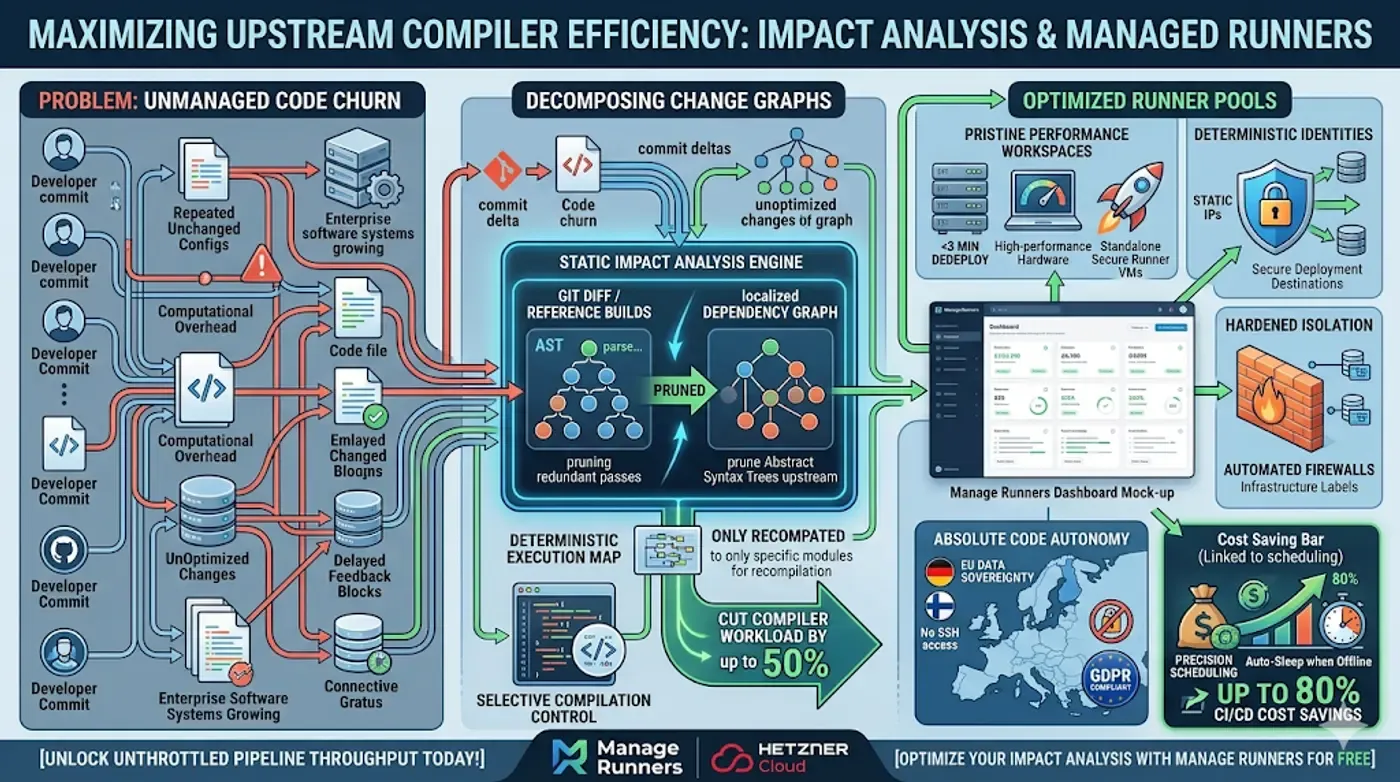
In the 2026 software delivery ecosystem, scaling continuous integration demands continuous optimization at the code translation layer. As enterprise software systems grow, rapid development tempos introduce intense code churn, forcing build engines to process millions of unchanged code configurations repeatedly. High-performance software engineering teams eliminate this computing overhead before raw source files ever hit a processor. By introducing automated static impact analysis, platform teams can selectively prune abstract syntax trees upstream, preventing redundant compiler passes and cutting overall build workloads by half.
1. The Architectural Cost of High Code Churn
When software developers execute modifications across interdependent codebases, changes to low-level interfaces propagate linearly through the local package structure. Unmanaged code churn forces compilers to construct dense Abstract Syntax Trees (ASTs) for entire directory systems, even if the structural change only modified a handful of modules.
Without upstream mapping, the compilation engine spends extensive processing cycles running dead-code elimination loops and type-checking routines on untouched semantic blocks. This memory and compute strain directly translates into pipeline congestion and delayed feedback blocks.
2. Implementing Predictive Impact Analysis
Resolving this translation bloat requires a shift toward predictive pipeline parsing. Instead of running a generic, full-scale compilation on every code ingestion hook, teams execute an structural impact analysis step to compare the logical differences between reference builds:
This process evaluates code deltas against a localized dependency graph. By isolating changed nodes, the pipeline can compute a deterministic execution map, ensuring that only the direct downstream dependants are recompiled while static, unaffected modules are instantly reused from storage mirrors.
3. Blueprint: Selective Compilation Control
Engineers can deploy custom change-detection logic directly within initial pipeline validation phases to filter the incoming payload dynamically:
#!/bin/bash
# Identify code churn delta relative to the primary origin reference
CHANGED_FILES=$(git diff --name-only ORIGIN/main...HEAD)

echo "Initializing static impact analysis..."
for file in $CHANGED_FILES; do
  if [[ "$file" =~ src/components/core/.* ]]; then
    echo "Core architectural component modified. Universal build triggered."
    export COMPILATION_SCOPE="full"
    break
  else
    echo "Isolating localized module variance: $file"
    export COMPILATION_SCOPE="selective"
  fi
done
4. Manage Runners: Ephemeral Compute for Intelligent Pipelines
Optimizing your dependency tracking structures yields minimal results if your execution nodes run on constrained, slow shared-cloud platforms. Manage Runners provides an effortless, automated dashboard to provision and manage dedicated GitLab runners on high-performance Hetzner Cloud infrastructure, delivering the raw processing capacity your parallel pipelines demand.
Our platform eliminates compilation bottlenecks by integrating clean infrastructure lifecycles directly into your optimized workflows:
- Pristine Performance Workspaces: Launch standalone, secure runner virtual machines optimized for heavy compilation steps in under 3 minutes via our centralized interface.
- Deterministic Identities: Every automated runner node receives a unique, permanent Static IP address, giving your security teams a clean network anchor to securely restrict deployment destinations.
- Hardened Isolation Perimeters: Protect your build nodes from lateral network exploits by programmatically mapping Hetzner Firewalls using infrastructure labels.
- Absolute Code Autonomy: Built to be fully GDPR compliant, all runner instances reside securely within your own EU-based Hetzner account (Germany/Finland). For total source-code isolation, Manage Runners maintains no SSH access to your runner VMs.
By shifting intensive compilation tracks onto dedicated Hetzner instances and utilizing our native precision scheduling to automatically sleep runners when your engineers are offline, teams routinely cut their monthly cloud infrastructure bills by up to 80% without sacrificing single-thread compilation speed.
5. Conclusion
Compiling unchanged code blocks is an unnecessary tax on engineering momentum. Pairing intelligent codebase filtering with the fast, isolated compute architecture provided by Manage Runners eliminates micro-architectural waste and guarantees an optimized path toward secure continuous delivery.
Ready to unlock unthrottled pipeline throughput? [Optimize your Impact Analysis with Manage Runners] and experience automated runner control on Hetzner Cloud.