In the 2026 DevOps landscape, the most critical vulnerability in your delivery pipeline isn't unpatched code it is identity exposure. Many software engineering teams rely on static cloud provider keys saved directly within their repository environment variables. This approach to credential management creates massive security vulnerabilities due to long token Time-to-Live (TTL) windows. If an upstream dependency is compromised or an engineer misconfigures a debug log, these permanent keys leak completely. Securing modern pipelines demands a zero-trust architecture powered by short-lived dynamic secrets that expire the exact moment a build stage concludes.
1. The Threat Profile of Static Variable Leaks
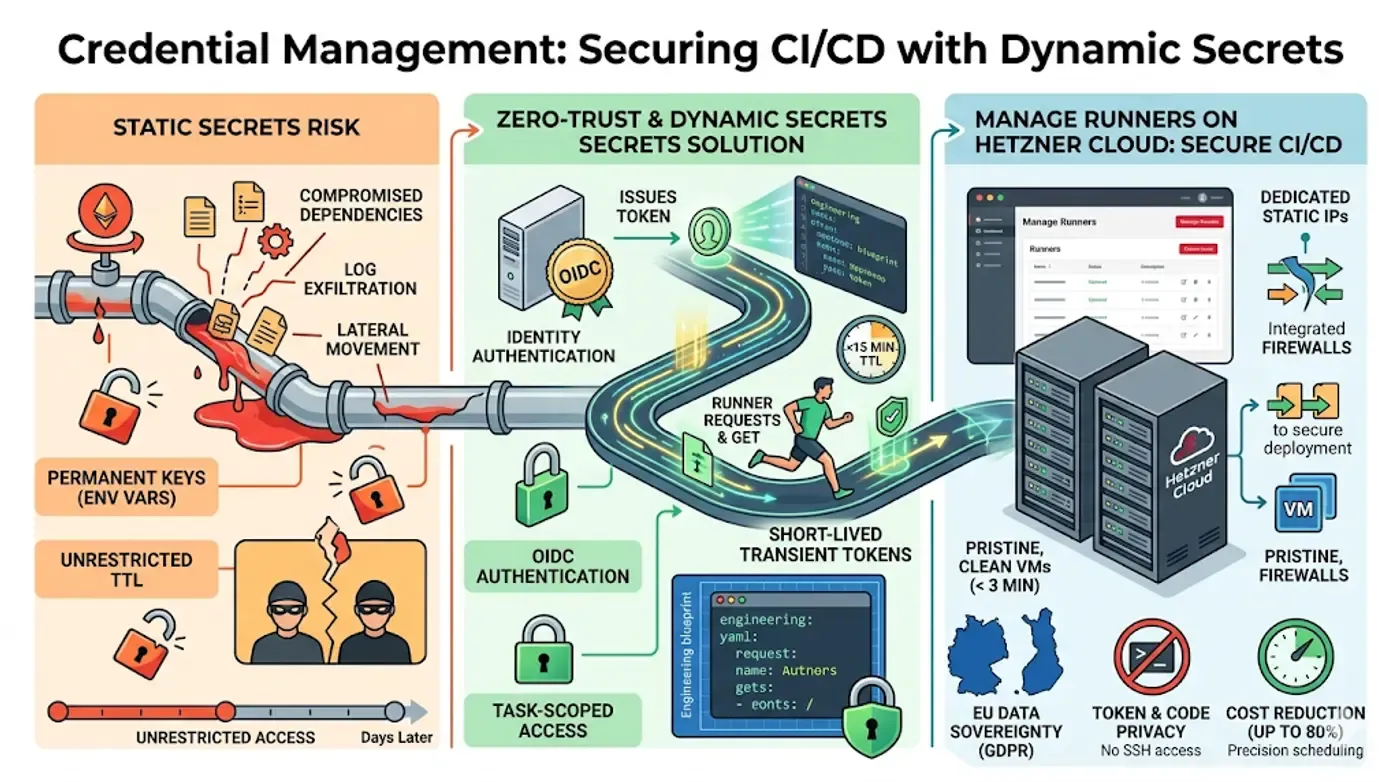
When you save a permanent AWS, GCP, or production database credential inside your CI/CD configuration dashboard, that secret is injected into every single running container. This structural exposure introduces severe risks:
- Log Exfiltration: Nested execution scripts or third-party test runners can dump all system environment variables directly into public build artifacts or terminal histories.
- Compromised Dependencies: A malicious package update injected via a supply chain attack can easily scrape running environments and upload active credentials to external collector servers.
- Lateral Infrastructure Access: Because these tokens lack strict expiration baselines, an attacker who steals a key at midnight can comfortably map out and exploit your internal network resources weeks later.
2. Architectural Blueprint: Implementing Dynamic Secrets via OIDC
Resolving credential exposure requires decoupling long-lived access parameters from the active build workspace. Instead of storing hardcoded access strings, platform engineers leverage OpenID Connect (OIDC) to authenticate temporary identity vectors on demand.
When a pipeline step initializes, the runner requests a transient, cryptographic token from a central identity provider. This token has an ultra-short TTL (typically less than 15 minutes) and is scoped strictly to the specific tasks required by that unique job branch.
# Engineering Blueprint: Requesting Short-Lived Cloud Provider Access
# Bypassing static variables through dynamic authorization hooks
assume_temporary_cloud_role:
  stage: deploy
  id_tokens:
    SIGSTORE_ID_TOKEN:
      aud: sigstore
  script:
    - export CLOUD_TOKEN=$(cloud-cli auth login --token-token "$SIGSTORE_ID_TOKEN" --ttl 10m)
    - cloud-cli deploy --cluster production-eu-west
By hardcoding a tight 10-minute expiration directly into the initialization loop, the stolen token becomes structurally useless to an outside attacker before they can complete a manual system probe.
3. Manage Runners: Isolated Infrastructure for Zero-Trust Pipelines
Constructing and maintaining a secure, zero-drift authentication environment across distributed infrastructure nodes manually generates intense operational toil. Manage Runners provides a centralized, automated platform to launch and manage high-performance GitLab runners on Hetzner Cloud, offering the ideal physical shield for sensitive operations.
Our control plane integrates directly into your localized data protection models to secure execution instances:
- Dedicated Static IP Architecture: Every automated runner receives a unique Static IP address. This allows security teams to implement airtight firewalls on internal deployment targets, ensuring application updates are rejected unless they originate from that specific, verified build node identity.
- Under 3 Minutes to Active State: Spin up pristine runner virtual machines dynamically using a glassmorphism-inspired UI. Every job executes on a completely clean slate, removing any risk of residual workspace variable cross-contamination.
- Absolute Code and Token Privacy: Built to be fully GDPR compliant, all runner VMs host safely inside your own EU data centers (Germany/Finland). Crucially, Manage Runners maintains no SSH access to your runner instances, ensuring your runtime secrets remain entirely your own.
- Automated Perimeter Hardening: Secure your execution space instantly by mapping Hetzner Firewalls via environment labels directly through our interface.
By moving your heavy automated workflows onto dedicated Hetzner servers and using our native precision scheduling to automatically pause runners when developers are offline, engineering teams routinely cut standard managed CI/CD infrastructure bills by up to 80% without compromising security.
4. Conclusion
Relying on permanent tokens in shared cloud clusters creates massive infrastructure exposure. Transitioning to modern credential management workflows and anchoring your pipelines with the isolated, ephemeral compute power of Manage Runners ensures your delivery engine remains fast, compliant, and uncompromised.
Ready to protect your infrastructure from credential leaks? [Secure your pipeline environments with Manage Runners] and experience automated, secure delivery on Hetzner Cloud.