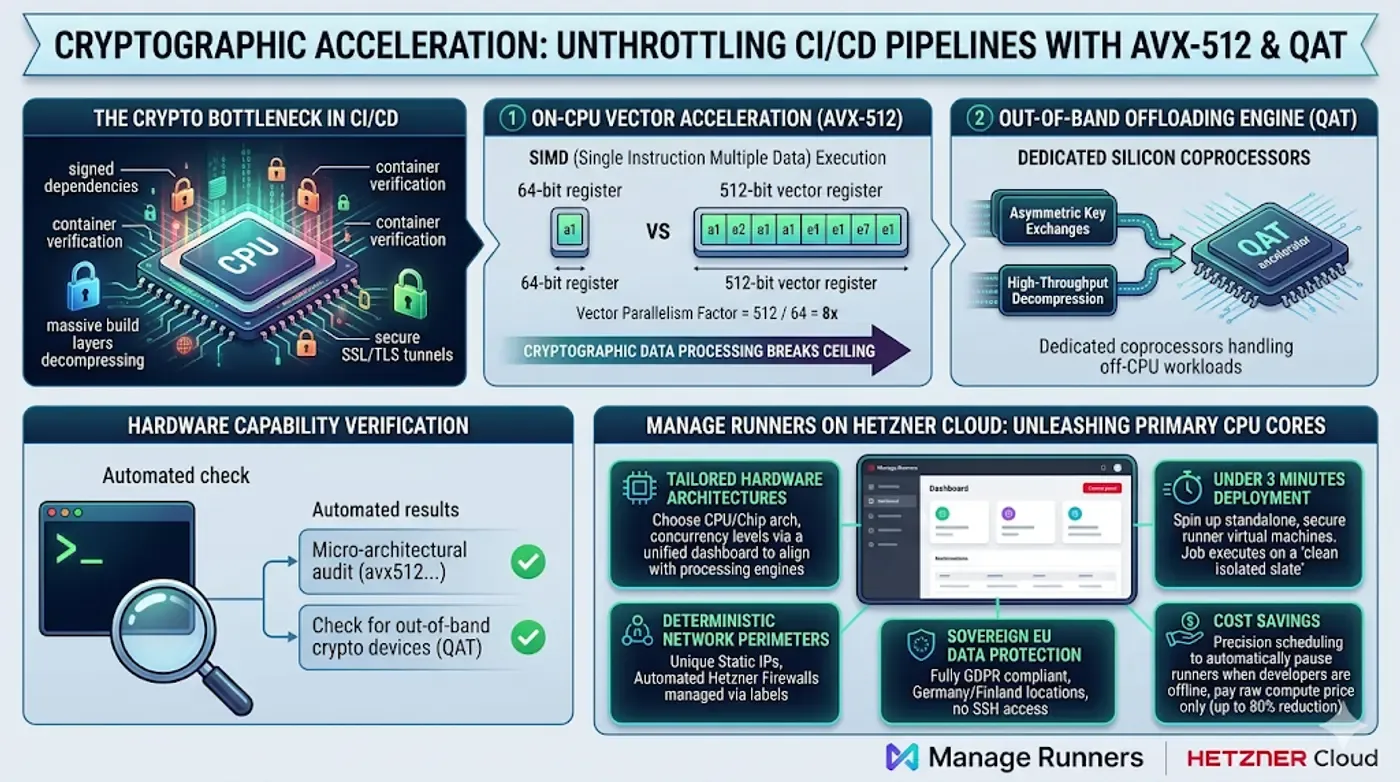
In the 2026 dev ecosystem, modern pipelines do far more than compile source code; they act as cryptographic gatekeepers. Between fetching thousands of signed dependencies over secure SSL/TLS tunnels, verifying container image provenance, and decompressing massive compressed build layers, standard processing cores face a quiet resource drain. To prevent your delivery workflows from being throttled by mathematical computations, infrastructure teams must look to hardware execution layers. Leveraging advanced instruction sets like avx-512 and dedicated offloading engines transforms your infrastructure through pure cryptographic acceleration, leaving your primary CPU cores free to execute builds at maximum clock speeds.
1. The Real Cost of Security Operations in CI/CD
Security is non-negotiable, but its computational tax is significant. Traditional architectures handle symmetric encryption, asymmetric handshakes, and hashing sequentially using standard scalar CPU instructions.
When your runner scales up to process hundreds of parallel webhooks or runs dense artifact unpacking tasks, your cores become bogged down by context-switching and integer multiplication loops. This processing penalty directly degrades pipeline throughput, driving up execution costs while leaving critical compiler processes starving for raw compute cycles.
2. Vectorization Mechanics: How AVX-512 Breaks the Ceiling
Advanced Vector Extensions 512 (avx-512) represent a paradigm shift in data processing. Instead of executing Single Instruction Single Data (SISD) operations, it leverages ultra-wide 512-bit vector registers to achieve true Single Instruction Multiple Data (SIMD) execution.
When processing secure transport handshakes or validating file signatures, the mathematical throughput can be calculated by analyzing register width scaling:
Vector Parallelism Factor = 512 bits / 64 bits (Standard Register) = 8 bits
This architectural shift allows a single processor cycle to validate eight times the amount of cryptographic data compared to legacy hardware profiles, directly removing the computing barrier on data streaming paths.
3. Offloading Compression with Intel QuickAssist Technology (QAT)
While vector instructions accelerate on-chip processing, hardware accelerators like Intel QuickAssist Technology (QAT) remove cryptographic and compression workloads from the CPU entirely. QAT utilizes dedicated silicon coprocessors to handle asymmetric key exchanges and high-throughput zlib/zstd decompression out-of-band.
By routing your pipeline's heavy package decompression and validation hooks through dedicated QAT rings, your primary execution threads gain immediate relief from resource exhaustion.
4. Hardware Verification Blueprint
To ensure your automated runners are actively exploiting these micro-architectural advantages, platform engineers must validate hardware capability maps before launching heavy workloads:
#!/bin/bash
# Micro-architectural audit: Verifying vector extensions and hardware crypto acceleration

echo "=== Evaluating Processor Vector Capabilities ==="
FLAGS=$(lscpu | grep -oE "avx512[^ ]*")

if [ -n "$FLAGS" ]; then
    echo "Compliant: Found accelerated vector extensions:"
    echo "$FLAGS"
else
    echo "WARNING: Running on non-vectorized hardware. Susceptible to crypto throttling."
fi

echo "=== Checking for Out-of-Band Cryptographic Hardware Devices ==="
if lspci | grep -i "QuickAssist" > /dev/null; then
    echo "QAT accelerator found. Ready for native offloading."
else
    echo "QAT absent. Falling back to host instruction loops."
fi
5. Manage Runners: Tailored Hardware Architectures on Hetzner Cloud
Manually provisioning optimized hypervisors, managing instruction sets, and hardening unmanaged runner clusters creates massive DevOps toil. Manage Runners provides a centralized, automated control plane to deploy and manage high-performance GitLab runners directly on Hetzner Cloud.
Our platform eliminates compilation and cryptographic bottlenecks through precise, automated infrastructure lifecycles:
- Hardware Selection Control: Choose specific CPU/Chip architectures and concurrency levels via a unified dashboard to align your pipelines with the exact processing engines required for heavy cryptographic acceleration.
- Under 3 Minutes to Active State: Instantly spin up standalone, secure runner virtual machines. Every job executes on a clean, isolated "blank slate."
- Deterministic Perimeters: Every runner receives a unique Static IP address and automated Hetzner Firewalls managed via labels, allowing you to establish secure whitelists on target deployment networks.
- Sovereign EU Data Protection: Fully GDPR compliant, all runner VMs host safely inside your own EU-based Hetzner account (Germany/Finland). For absolute code security, Manage Runners maintains no SSH access to your runner instances.
By executing workloads on unthrottled hardware paths and leveraging our native precision scheduling to automatically pause runners when developers are offline, engineering teams routinely reduce standard managed infrastructure costs by up to 80% while restoring uncompromised processing velocity to their delivery pipelines.
6. Conclusion
Cryptographic handshakes shouldn't act as a tax on your delivery speeds. Transitioning to specialized instruction sets and anchoring your pipelines with the isolated, automated compute power of Manage Runners eliminates performance bottlenecks and secures a fast, predictable path toward continuous integration.
Ready to unlock unthrottled pipeline throughput? [Optimize your Cryptographic Acceleration with Manage Runners] and experience automated runner control on Hetzner Cloud.