When a global registry like npm, PyPI, or Maven experiences a localized outage or routing failure, thousands of enterprise deployment pipelines grind to a halt. Relying directly on public repositories for every build step creates a critical point of failure. To insulate your delivery workflows against external chaos, your DevOps infrastructure must shift toward automated, self-contained package management architectures that shield compilation steps and enforce absolute build reproducibility.
1. The Threat Model: Upstream Dependency Faults
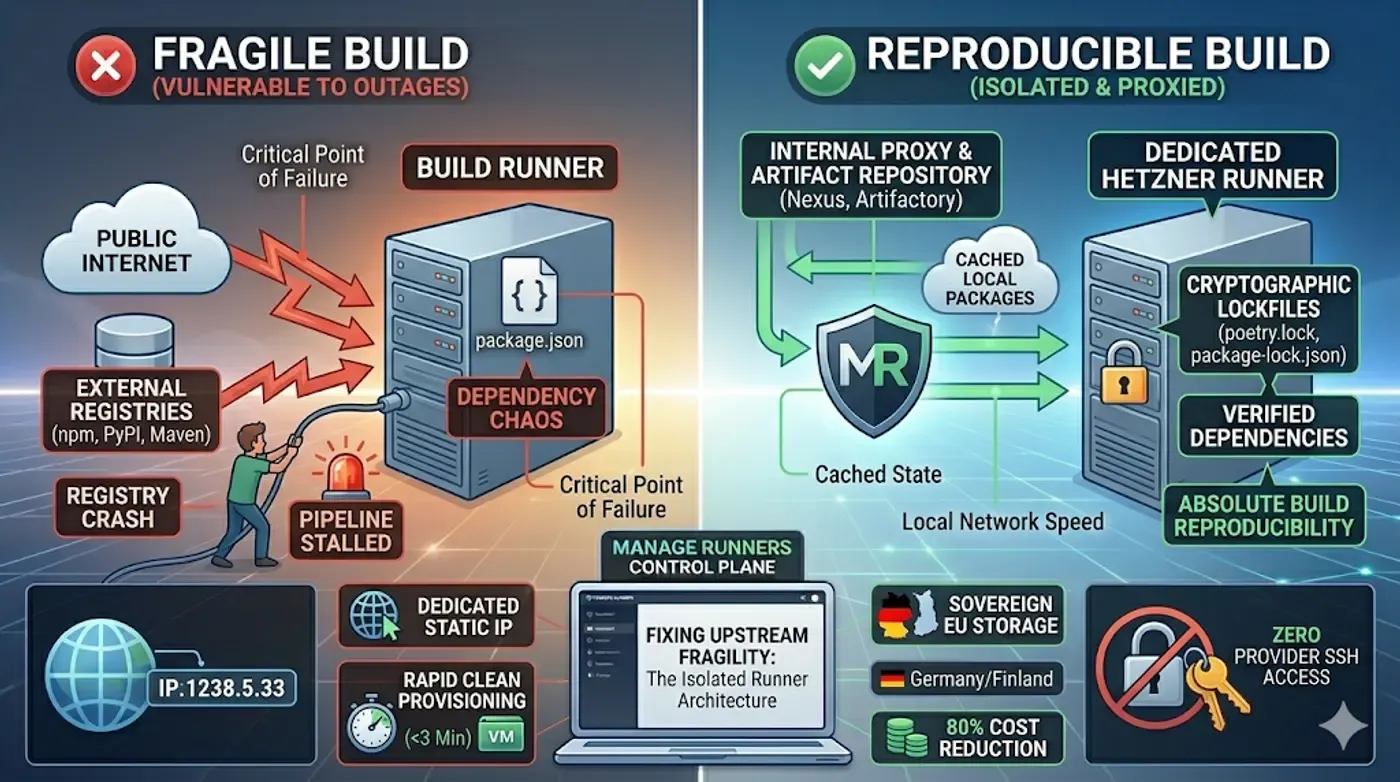
Every time a runner executes npm ci or pip install against a vanilla public upstream server, it risks pipeline blocking. If the external registry drops offline, experiences a DNS issue, or suffers from a malicious package pull, your build fails.
True build reproducibility means that an artifact compiled today will be completely identical to one compiled six months from now, regardless of the status of the public internet. If your runner dynamically fetches unpinned or unverified packages directly from external registries, your system is vulnerable to upstream configuration changes and external service health.
2. Resolution: Private Proxies and Lockfile Enforcement
Mitigating upstream infrastructure failures requires a two-pronged structural response: deterministic state tracking and local network caching.
- Cryptographic Lockfiles: Commit lockfiles (
package-lock.json,poetry.lock,Cargo.lock) directly into version control. These manifest arrays preserve the exact version strings and SHA checksum signatures of every sub-dependency. - Internal Proxying: Configure your build environment to query local or private artifact repositories (such as Nexus, Artifactory, or a local registry mirror) instead of public endpoints. These storage systems cache packages locally upon their first request, ensuring that subsequent pipelines pull straight from a local, high-speed pool.
# Performance Blueprint: Explicit Registry Overrides
# Redirecting the package management agent to route requests
# through an authenticated local enterprise proxy mirror
before_script:
  - npm config set registry https://nexus.internal.enterprise/repository/npm-group/
  - echo "//nexus.internal.enterprise/:_authToken=${CI_PROXY_TOKEN}" > .npmrc
3. Manage Runners: Immutable Node Architecture for Sovereign Pipelines
Enforcing strict package management isolation layers manually across distributed infrastructure components creates significant operational overhead. Manage Runners delivers a centralized, highly automated dashboard to deploy and scale dedicated GitLab runners on Hetzner Cloud without the DevOps toil.
Our control plane integrates directly into your localized data patterns to defend your pipeline stability:
- Dedicated Static IP Identities: Every runner node receives a permanent Static IP address. This allows security teams to configure strict firewall whitelists on your private package mirrors, blocking public internet egress while permitting secure, authenticated access to internal code dependencies.
- Rapid Clean Provisioning: Spin up identical, hardened runner VMs in under 3 minutes straight from our modern, glassmorphism-inspired interface. Each job can execute on a fresh "blank slate" to prevent corrupted local cache states from polluting your builds.
- Sovereign EU Storage Protection: All runner virtual machines are hosted within your own GDPR-compliant Hetzner account across premier data hubs in Germany and Finland.
- Zero Provider Visibility: For absolute code privacy, Manage Runners maintains no SSH access to your runner instances, leaving your configuration secure.
By moving your automated workflows onto dedicated Hetzner servers and using our native precision scheduling to automatically pause runners when developers aren't working, teams cut their cloud bills by up to 80% while establishing an uncompromised foundation for build reproducibility.
4. Conclusion
Relying purely on the constant availability of external public systems exposes your release cycle to unnecessary risks. Transitioning to local, proxied package consumption and utilizing the isolated, high-speed orchestration of Manage Runners transforms your infrastructure into a resilient, self-contained build facility.
Ready to protect your pipeline from external dependency crashes? [Secure your Package Management with Manage Runners] and build with total consistency on Hetzner Cloud.