In the 2026 engineering landscape, "developer velocity" is the only metric that truly separates market leaders from laggards. Yet, most organizations ignore a silent thief of time: the gap between a git push and a build result. When a pipeline takes 10 minutes or longer, it triggers a chain reaction of context switching that fragments a developer's day. Understanding the mental tax of infrastructure latency is critical for any team looking to move beyond "toil" and back into deep work.
1. The Cognitive Load: What is Context Switching?
To improve engineering culture, we must first answer: what is context switching in the world of high-performance coding? At its core, it is the process of storing the state of one task in mental "RAM" to focus on another.
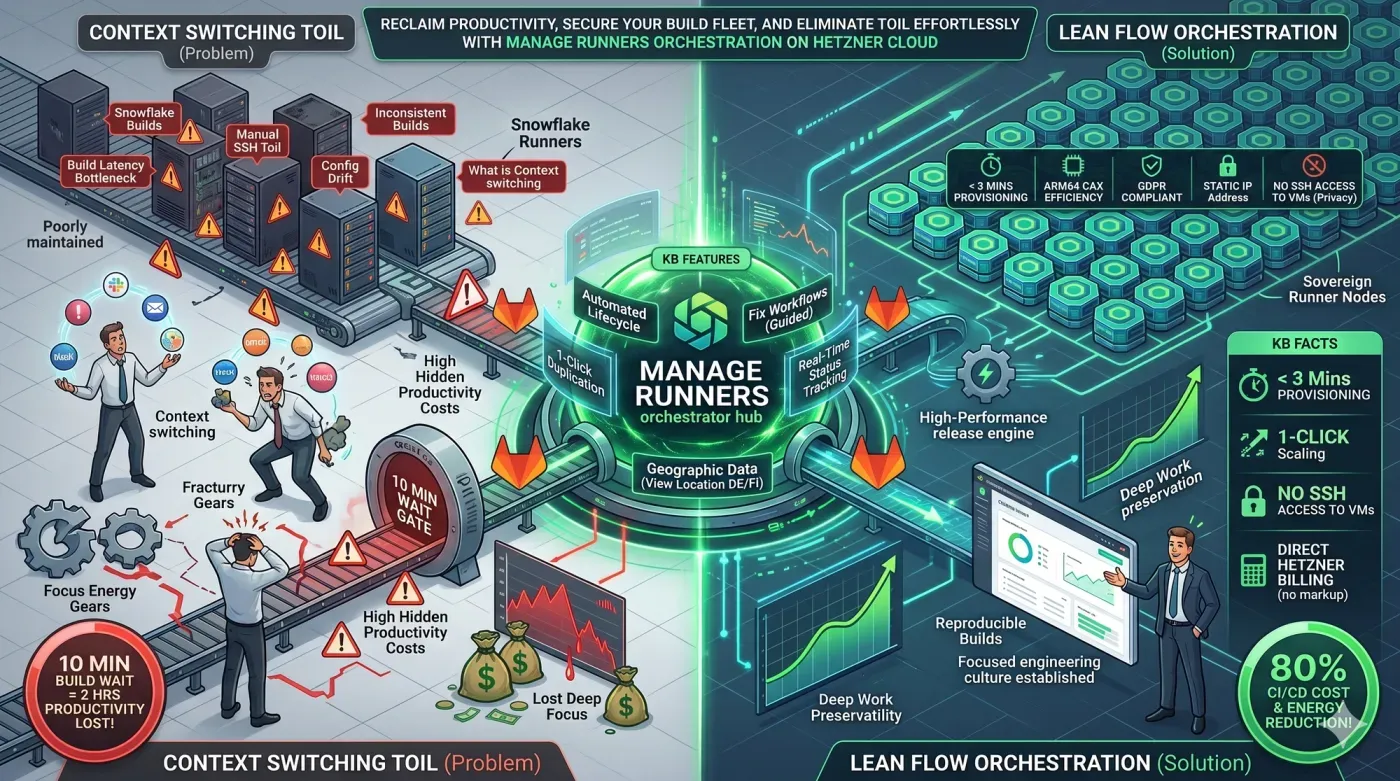
When a developer finishes a feature and triggers a CI/CD pipeline, they enter a state of limbo. If that build isn't near-instant, the brain instinctively seeks a secondary task: checking Slack, responding to emails, or starting a new branch. The problem is that the "startup time" to return to the original task’s state can take up to 25 minutes. Context switching isn't just a 10-minute break; it's a total reset of the mental "Flow State."
2. The 10-Minute Myth: Calculating the Hidden Loss
A 10-minute wait for a build result seems trivial on a spreadsheet, but the organizational impact is staggering.
- The Switch: Build starts. Developer opens a code review for a teammate.
- The Interruption: 10 minutes later, the build fails due to a minor linting error.
- The Recovery: The developer must stop the code review, reload the context of their original feature, fix the linter, and push again.
By the time they are back in the "zone" for the original task, they have lost significantly more than the 10 minutes the build took. For a typical engineer, three such switches a day result in roughly 2 hours of lost deep-focus time.
| Build Duration | Developer Behavior | Mental Impact |
|---|---|---|
| < 2 Minutes | Stays on task / "The Zone" | Continuous Flow |
| 2 - 5 Minutes | Minor distraction (Slack/Email) | Fragmented Attention |
| > 10 Minutes | Complete context switching | High Re-entry Cost |
3. Solving Build Latency: The Engineering Approach
To prevent the high cost of what is context switching, teams must treat build speed as a tier-one feature. This requires moving away from shared, underpowered runners and toward dedicated, high-performance infrastructure.
Optimization Strategies:
- Architecture Matching: Use ARM64 runners (like Hetzner CAX servers) to match local dev environments, reducing translation overhead.
- Disk I/O Prioritization: Ensure build runners use NVMe-backed storage to handle heavy Docker layer extractions.
- Automated Lifecycle: Infrastructure should be "ready before it's needed."
4. Manage Runners: The Flow-Preservation Engine
Manage Runners was built to address the psychological and financial cost of slow builds. By automating the deployment of high-performance GitLab and GitHub runners on Hetzner Cloud, we ensure your developers never have to leave "The Zone."
- Provisioning in < 3 Minutes: Stop waiting for "Pending" states. Spin up a new, hardened runner exactly when you need it.
- Standardized Performance: Use 1-click duplication to ensure every runner in your fleet is a "Golden Image," eliminating the "it works on my machine" errors that trigger late-pipeline switches.
- 80% Cost Savings: By leveraging Hetzner's low-cost compute directly and using our native scheduling to pause runners during idle hours, you get dedicated performance at a fraction of the cost of managed services.
- Security & Identity: Every runner gets a Static IP address for secure whitelisting. Importantly, Manage Runners has no SSH access to your VMs, ensuring your proprietary code stays truly private.
5. Conclusion
Developer focus is your most expensive resource. By reducing build latency and eliminating the need for constant context switching, you aren't just saving server costs you are reclaiming hours of peak productivity for your team.
Ready to keep your developers in the flow? [Start optimizing your build fleet with Manage Runners] and build a faster, more focused engineering culture.