As the mandatory reporting deadlines for the EU Cyber Resilience Act (CRA) approach, organizations distributing digital products in the European market face a profound structural shift. Achieving comprehensive supply chain transparency is no longer a checklist item for legal departments; it is an active engineering requirement. To avoid market exclusions and severe liability, development teams must transform their standard CI/CD pipelines into automated software quality factories that output a validated software bill of materials (SBOM) with every single compilation.
1. The Regulatory Directive: Anatomy of the EU CRA
The EU CRA introduces a horizontal legal framework demanding mandatory cybersecurity baselines across a product’s entire lifecycle. Under Annex I, manufacturers must explicitly identify and document all components and known vulnerabilities. This means capturing both direct and transitive dependencies in a machine-readable format (such as SPDX or CycloneDX) before any software version can be legally placed on the market. Manual point-in-time audits are useless in this landscape; your delivery pipelines must compile compliance metadata systematically.
2. Architecture: Turning Runners into Compliance Testing Factories
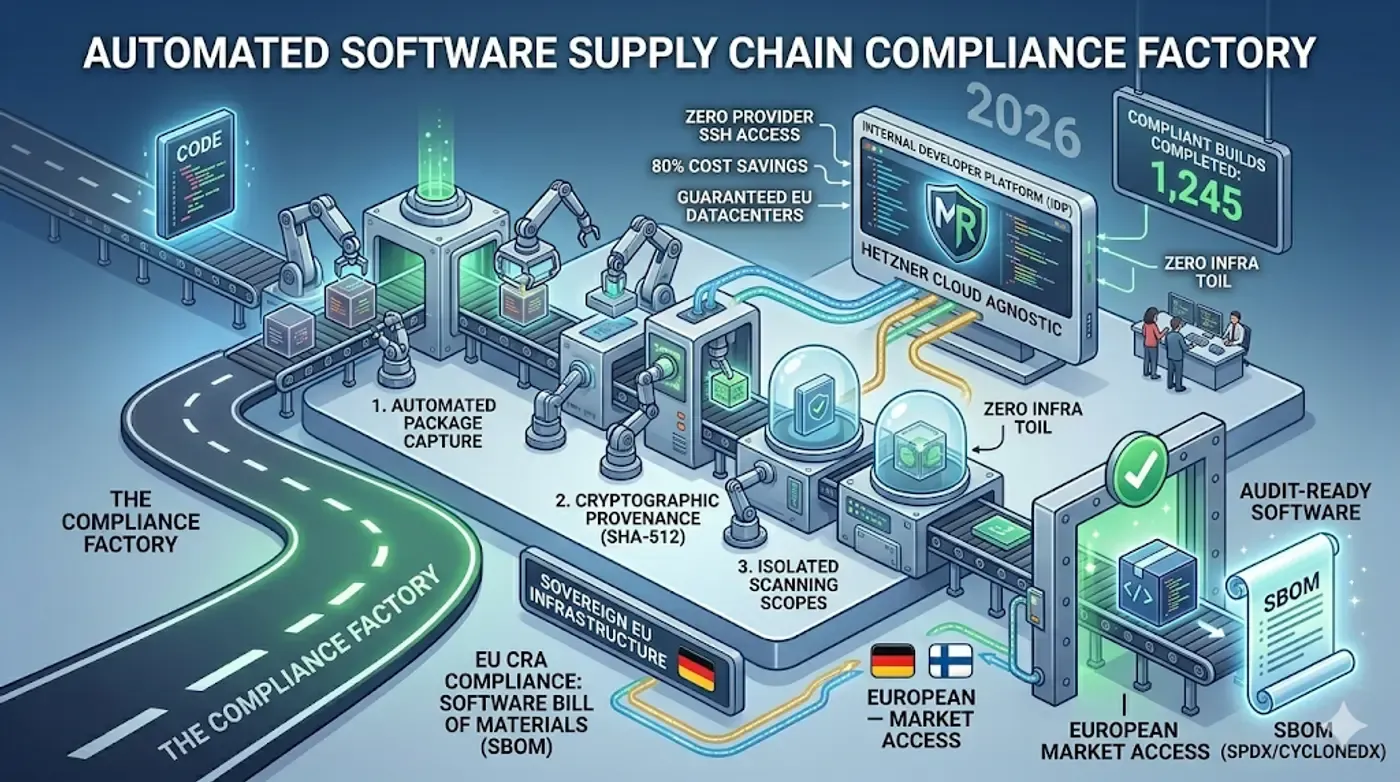
To fulfill the requirements of strict digital audits without crushing deployment velocity, the build runner must operate as a highly optimized testing engine. A reliable compliance-factory architecture relies on three explicit pipeline layers:
- Automated Package Capture: Extracting package fingerprints immediately after dependency resolution.
- Cryptographic Provenance: Generating SHA-512 checksums for every compiled asset to guarantee build integrity.
- Isolated Scanning Scopes: Running dependency scanners in transient environments to prevent data cross-contamination.
# Example: Automated SBOM Generation Factor Step
generate_sbom_specification:
  stage: test
  image: cyclonedx/cyclonedx-cli:latest
  script:
    - cyclonedx-bom -o bom.json --format json --recursive
  artifacts:
    paths:
      - bom.json
3. Manage Runners: Orchestrating Sovereign, Audit-Ready Pipelines
Generating a machine-readable software bill of materials continuously demands dedicated, high-performance compute resources. Offloading heavy compliance scanning onto throttled, generic cloud platforms degrades your pipeline efficiency. Manage Runners provides a centralized control plane designed to eliminate the infrastructure overhead of running secure, compliant build environments on Hetzner Cloud.
| Compliance Vector | Unmanaged Static Clusters | Automated Control with Manage Runners |
|---|---|---|
| Deployment Speed | High setup toil (30+ mins) | Under 3 Minutes to Active State |
| Data Residency | Questionable jurisdiction | Guaranteed EU Datacenters (DE/FI) |
| Workspace Isolation | High kernel escape risk | Dedicated, Transient Hetzner VMs |
| Control Plane Security | Shared administrative access | Zero Provider SSH Access to VMs |
By deploying your custom GitLab runners directly within your own sovereign Hetzner account, you keep your source code and secrets fully isolated. Every runner receives a dedicated Static IP address to safeguard connection scopes, while Hetzner Firewalls are assigned programmatically via labels. Manage Runners absorbs the maintenance burden with automated "Fix" workflows, allowing your DevOps teams to track status metrics in real-time.
Using precision scheduling to eliminate idle infrastructure waste, you can cut your monthly cloud bills by up to 80% while establishing an uncompromised foundation for supply chain transparency.
4. Conclusion
True cyber resilience cannot be simulated. Automating your software asset tracking is the most direct strategy to secure your supply chain and protect your market access.
Ready to bulletproof your regulatory architecture? [Start your Software Bill of Materials automation with Manage Runners] and build an audit-ready pipeline on sovereign EU infrastructure.