In the 2026 regulatory environment, data sovereignty is no longer a checkbox, it is a competitive moat. For DevOps teams, the build infrastructure is often the "weak link" in audits. Achieving SOC2 or GDPR standards requires more than just good intentions; it demands a shift toward compliance automation. By automating the lifecycle and security of your CI/CD runners, you transform your infrastructure from an audit liability into a provably secure asset, leveraging high-performance EU-based resources.
1. The Compliance Barrier: Why Build Infrastructure Fails Audits
Most organizations fail to realize that their CI/CD runners handle sensitive secrets, source code, and potentially PII. Traditional managed runner services often host data on US-based servers, creating an immediate conflict with GDPR. Furthermore, "snowflake" runners instances manually configured and never updated lack the logs and standardized security postures required for SOC2. Without compliance automation, your team is forced into a cycle of manual evidence gathering that is prone to human error and high operational overhead.
2. The Shift to Compliance Automation Tools
To bridge the gap between "fast delivery" and "total compliance," engineering teams are turning to specialized compliance automation tools. These tools move beyond simple scanning; they enforce infrastructure standards at the moment of creation.
Effective compliance automation ensures:
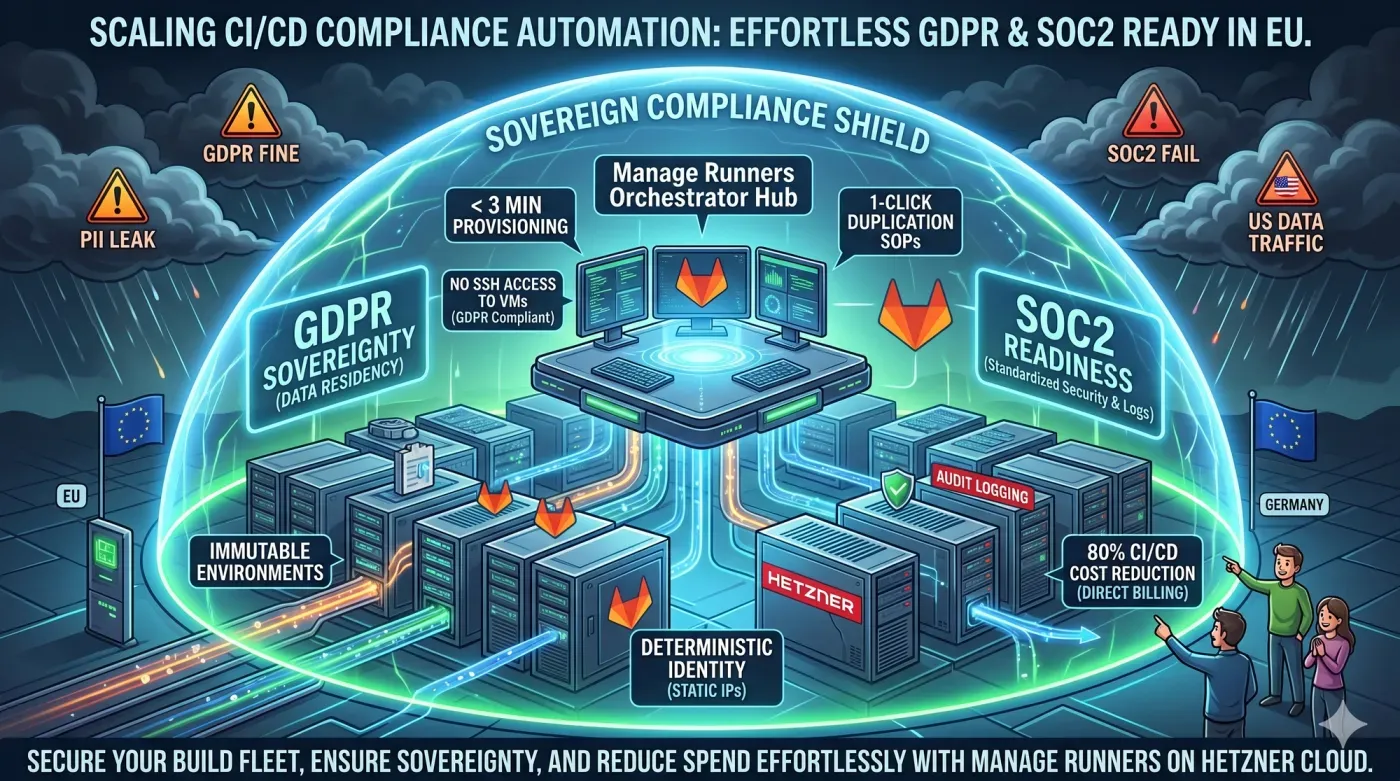
- Data Residency: Infrastructure stays within specific legal jurisdictions (e.g., Germany/EU).
- Immutable Environments: Runners are redeployed from clean templates, preventing configuration drift.
- Audit Logging: Every lifecycle event (Creation, Start, Stop, Error) is tracked and visible.
3. Technical Value: Hardening the Runner Perimeter
Meeting SOC2 requirements often boils down to network isolation and access control. Using an automated orchestration layer allows you to bake these requirements into your YAML configurations.
# Example: Compliance-Validated Build Job
# Ensuring the job only runs on GDPR-compliant EU infrastructure
secure_build:
  stage: build
  tags:
    - hetzner-eu-compliant-runner # Orchestrated via Manage Runners
  script:
    - echo "Running build on hardened, GDPR-compliant VM"
    - ./deploy_script.sh
  only:
    - production
By assigning Static IP addresses to your runners, you can whitelist access to sensitive internal resources, ensuring that your CI/CD fleet has a deterministic identity for security audits.
4. Manage Runners: The Effortless Path to Compliance
Manage Runners is built to solve the compliance headache for teams using Hetzner Cloud. We provide the orchestration layer that makes compliance automation a standard part of your DevOps workflow.
- GDPR Sovereignty: Our runners are hosted in your own Hetzner account, primarily in Germany and the EU, ensuring data residency compliance.
- Non-Invasive Security: Unlike many compliance automation tools, Manage Runners does not have SSH access to your runner VMs. Your data and your build environment stay entirely under your control.
- Standardized SOPs: Use 1-click duplication to ensure every new runner follows your organization’s approved hardware and firewall security labels.
- Automated Lifecycle: Provision clean, secure runners in under 3 minutes, eliminating the risk of long-lived, unpatched "snowflake" servers.
Manage Runners empowers you to stop worrying about audit toil. You pay Hetzner directly for the compute (reclaiming up to 80% of your budget) while we provide the industrial-grade automation needed to stay compliant.
5. Conclusion
Building a secure release pipeline shouldn't be a manual burden. By embracing compliance automation, you protect your data, satisfy your auditors, and free your developers to focus on shipping code.
Ready to secure your build fleet? [Start your Compliance Automation journey with Manage Runners] and scale your infrastructure with total confidence.