The hidden killer of engineering productivity isn't a lack of talent, it’s the accumulation of "janitorial" tasks. When your senior DevOps engineers spend nearly a third of their week manually patching, restarting, or "cleaning up" CI/CD runners, you are paying a massive intellectual tax. This repetitive work drastically inflates the cognitive load of your team, forcing them to troubleshoot the plumbing rather than architecting the product.
1. The Toil Trap: Measuring Intellectual Waste
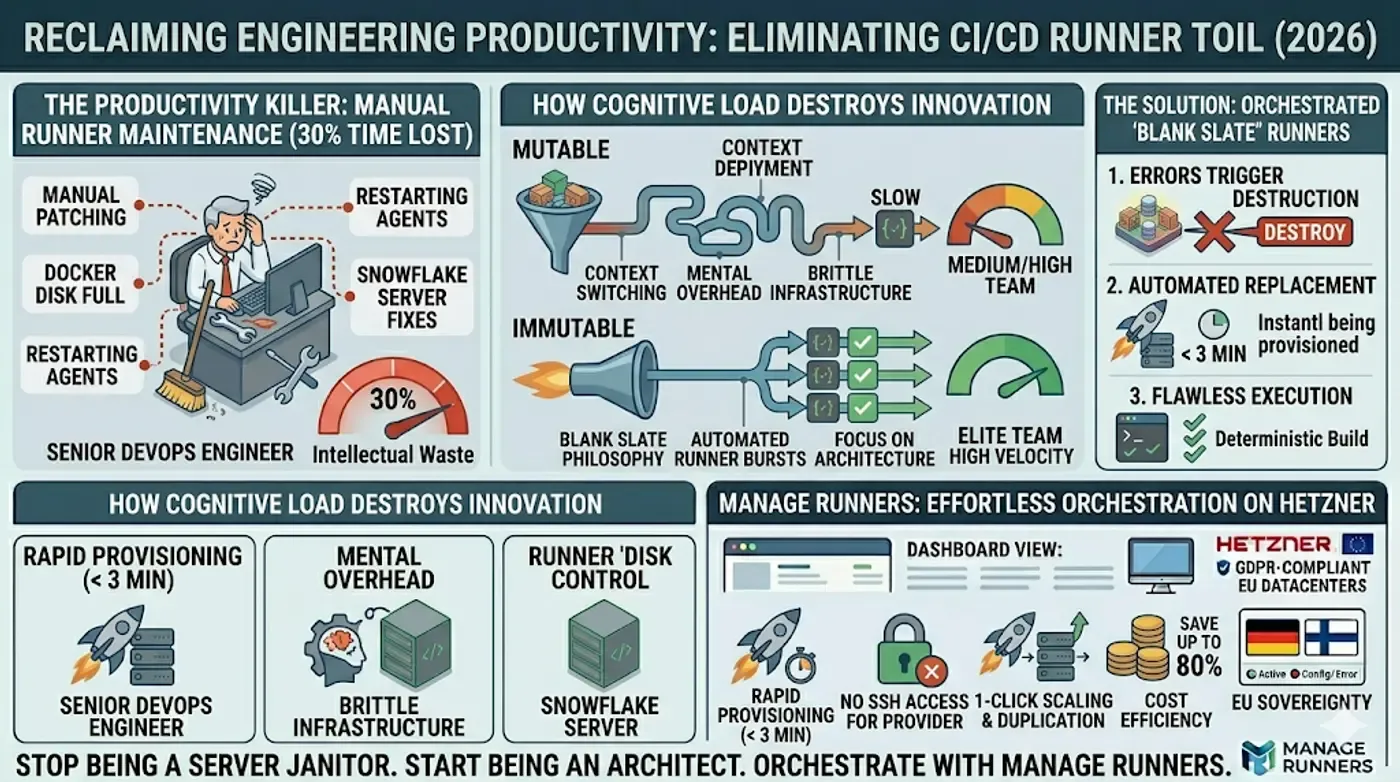
In modern Site Reliability Engineering, we define "toil" as work that is manual, repetitive, and lacks long-term value. For many organizations, runner management is the ultimate toil. Every time a GitLab runner hangs or a Docker-in-Docker executor fills up a disk, a high-salaried engineer is pulled away from strategic work. This isn't just a loss of hours; it’s a loss of momentum. When 30% of a senior’s time is spent on maintenance, you aren't just losing 12 hours a week you're losing the most complex problem-solving capacity your company has.
2. How Cognitive Load Destroys Innovation
Cognitive load refers to the mental effort required to complete a task. In infrastructure, high load is caused by "snowflake" runners servers with manual quirks that require specialized knowledge to fix.
- Context Switching: Moving from feature deployment to runner troubleshooting shatters focus.
- Mental Overhead: Keeping track of manual SSH configurations across a fleet of runners.
- Brittle Infrastructure: Teams become afraid to update pipelines because the underlying infrastructure is inconsistent.
Reducing this load is the most direct lever for increasing engineering productivity. If an engineer knows the infrastructure is ephemeral and automated, they can push code with confidence.
3. Moving Toward Orchestrated Infrastructure
To reclaim that lost 30%, teams must shift from "cleaning" servers to orchestrating them. This means adopting a "blank slate" philosophy: if a runner exhibits an error, it is automatically destroyed and replaced in minutes, not manually investigated via SSH.
4. Manage Runners: Focus on Code, Not Maintenance
Manage Runners was built to eliminate the janitorial work of CI/CD by providing a centralized dashboard for GitLab runners on Hetzner Cloud.
- Under 3 Minutes to Active: Provision a fresh, hardened runner instantly, bypassing the manual setup toil.
- Reduce Cognitive Load: Use automated "Fix" workflows for common deployment issues and 1-click scaling to replicate proven environments.
- Cost Efficiency: Slash expenses by up to 80% compared to managed solutions through direct Hetzner billing and precision scheduling.
- Security & Sovereignty: Host runners in your own EU-based account (Germany/Finland). Critically, Manage Runners has no SSH access to your VMs, ensuring total privacy and reducing your security cognitive load.
By automating the lifecycle of your build fleet, you allow your senior engineers to stop acting as server janitors and return to being architects.
5. Conclusion
High-performance teams don't just work harder; they work on the right things. By automating runner infrastructure and lowering the cognitive load on your DevOps team, you unlock the full potential of your engineering productivity.
Ready to reclaim your team's time? [Boost your Engineering Productivity with Manage Runners] and start scaling without the maintenance headache.