In the 2026 corporate landscape, ESG compliance has transitioned from a boardroom buzzword to a rigorous reporting requirement. IT departments are no longer shielded from sustainability audits; they are now expected to provide granular data on carbon footprints and data governance. For organizations looking to modernize, the choice of CI/CD infrastructure is a primary lever for meeting these standards. By leveraging high-efficiency cloud resources and automated orchestration, IT leaders can transform their "cost centers" into benchmarks of corporate responsibility.
1. The Environmental Pillar: Decarbonizing the Build Pipeline
The "E" in ESG focuses heavily on energy consumption. Traditional data centers and "always-on" legacy runners are massive energy drains. To meet ESG compliance targets, IT departments must optimize their compute usage.
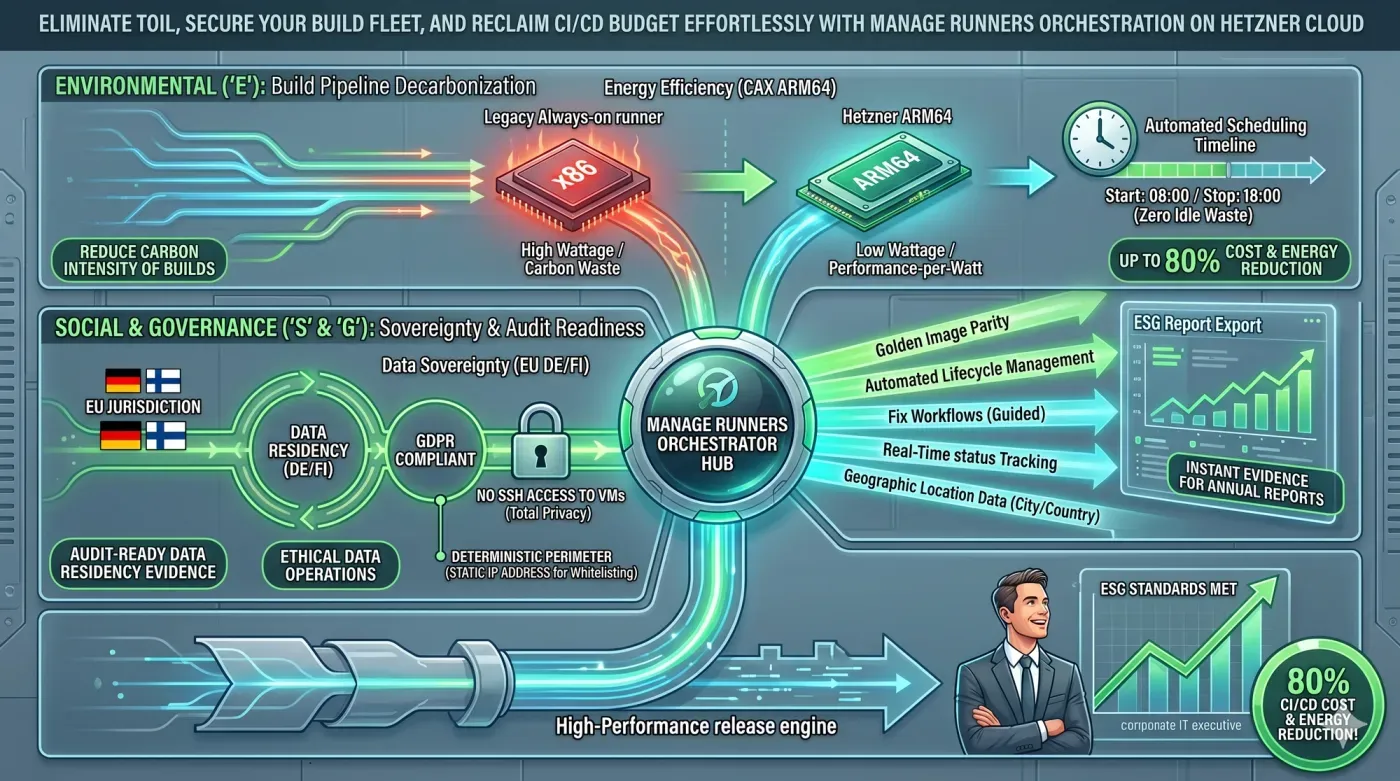
Energy Efficiency via Hardware Selection Choosing the right architecture is a technical imperative. Modern ARM64 processors (such as the Hetzner CAX line) offer significantly higher performance-per-watt compared to aging x86 infrastructure. This reduction in raw power draw directly lowers the carbon intensity of every software build.
Eliminating Idle Waste A significant portion of IT's carbon footprint comes from "zombie" servers runners that sit active during weekends or overnight while no code is being pushed. Implementing precision scheduling ensures that infrastructure only draws power when it is delivering value.
# Example: Reducing Carbon Footprint via Automated Scheduling
# Define runner availability to match team active hours (IANA Timezone)
runner_schedule:
  start: "08:00"
  stop: "18:00"
  timezone: "Europe/Berlin"
  days: ["Monday", "Tuesday", "Wednesday", "Thursday", "Friday"]
2. Social and Governance: Data Sovereignty as a Standard
Social responsibility and Governance ("S" and "G") often center on data privacy and ethical operations. In a globalized world, knowing exactly where your data is processed is non-negotiable for esg compliance.
To satisfy governance audits, build logs and proprietary code must remain within protected jurisdictions. Processing data in EU-based data centers (like Germany or Finland) ensures compliance with the world's strictest privacy laws. Furthermore, maintaining a Static IP address for runners allows IT to restrict access to sensitive internal resources, creating a deterministic and auditable security perimeter.
3. Integrating ESG Compliance Software into DevOps
While many look for specialized ESG compliance software for high-level reporting, the actual "heavy lifting" happens at the infrastructure layer. A platform that provides real-time status tracking, geographic data (City and Country), and centralized lifecycle management allows IT teams to export the necessary evidence for annual reports instantly. This replaces manual "toil" and guessing with verifiable, automated data points.
4. Manage Runners: Your Partner in ESG-Ready Infrastructure
Manage Runners is designed to help modern IT departments meet these rigorous standards without sacrificing performance or budget. We provide the orchestration layer that makes esg compliance a byproduct of efficient DevOps.
- Environmental Impact: We leverage Hetzner’s high-efficiency ARM64 servers and provide native scheduling to ensure you only pay for (and power) runners when they are in use, reducing energy waste and cutting costs by up to 80%.
- Governance & Security: We guarantee data sovereignty. All runners are hosted in your own Hetzner account in the EU. Importantly, Manage Runners has no SSH access to your VMs, ensuring total privacy and GDPR compliance.
- Audit-Ready Reporting: Our glassmorphism-inspired dashboard provides real-time connectivity data, IPv4/IPv6 addresses, and geographic locations for every runner in your fleet.
- Rapid Deployment: Provision a secure, standardized runner in under 3 minutes, ensuring your infrastructure follows approved security labels and firewalls every time.
By moving away from unmanaged "snowflake" servers and toward automated orchestration, your department can provide the transparency and efficiency required for the 2026 fiscal year.
5. Conclusion
Achieving ESG compliance in IT is about making smarter infrastructure choices. When you optimize for performance and cost, sustainability often follows.
Ready to simplify your reporting and slash your carbon footprint? [Start your ESG-compliant CI/CD journey with Manage Runners] and build a greener, more secure future.