When analyzing pipeline inefficiencies, engineering teams frequently default to profiling test suites or compiler flags. However, modern telemetry reveals a more silent performance drain: internal transport mechanics. In many enterprise pipelines, up to 40% of total runtime is entirely consumed by packing, moving, and unpacking raw .tar archives across network registries. Resolving this systemic lag requires moving past generic configurations toward precision artifact management and deep infrastructure alignment.
1. The Hidden Cost of Monolithic Tarballs
The standard approach to persisting states between pipeline stages relies on archive serialization grouping workspaces into a standard tarball and pushing it to a central registry.
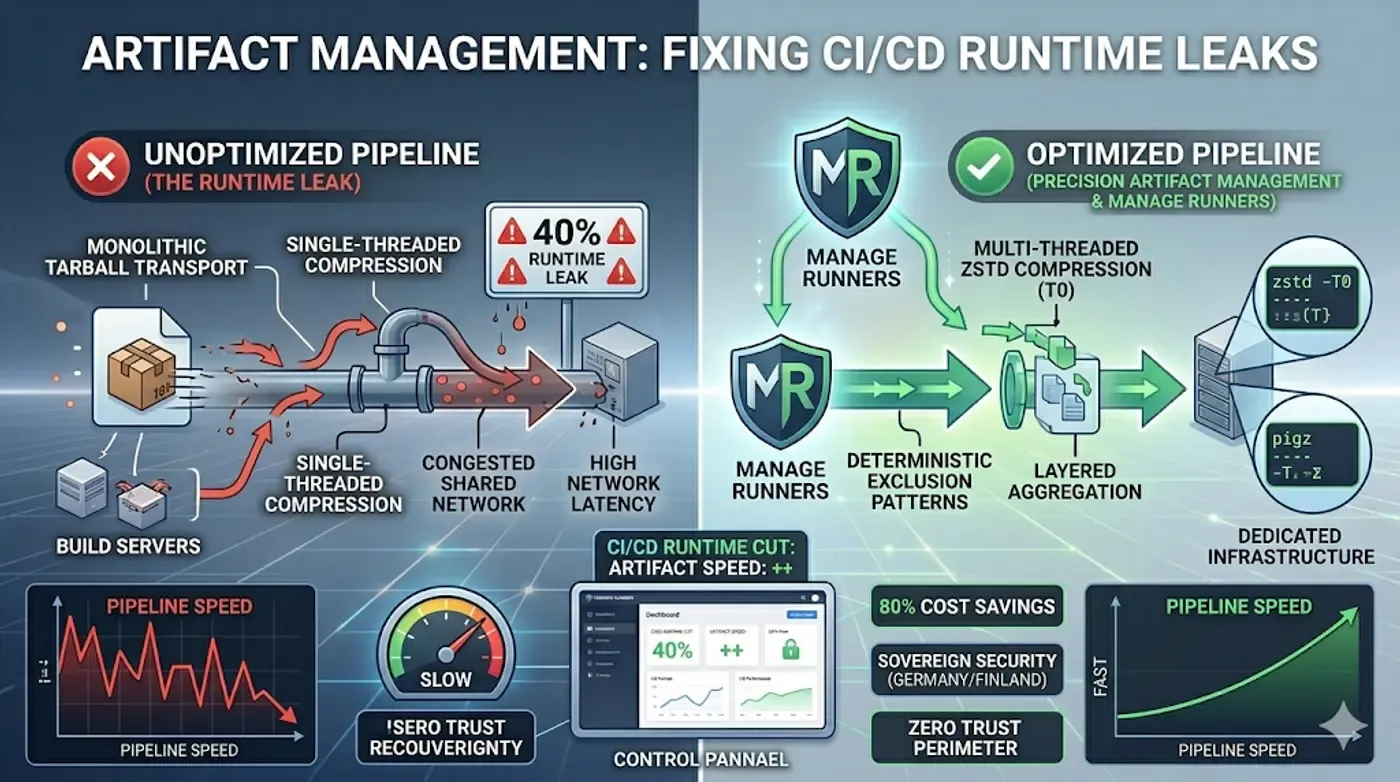
The core issue stems from single-threaded compression bottlenecks paired with network serialization. When your runner constructs an unoptimized .tar file containing thousands of small node modules, intermediate binaries, or build caches, it incurs a severe double penalty: CPU starvation during the initial compression phase, followed by high network latency as the monolithic file traverses congested shared internal networks.
2. Technical Mechanics of Storage Optimization
To eliminate this data transfer tax, teams must implement programmatic storage optimization rules straight inside their workspace configurations. This involves three technical interventions:
- Multi-threaded Compression Engines: Replacing default single-threaded compression with tools like
zstdorpigzto utilize multi-core architectures fully. - Deterministic Exclusion Patterns: Stripping out transient caches, temporary build logs, and test coverage reports before serialization begins.
- Layered Aggregation: Splitting static, unchanging dependencies away from dynamic, rapidly changing application builds to maximize layer reuse.
# Optimization Framework: Exploiting Multi-Core Compression
# Utilizing zstd parallel processing to bypass the single-thread barrier
pack_optimized_artifacts:
  stage: upload
  script:
    - tar --use-compress-program="zstd -T0 -1" -cf workspace_cache.tar.zst ./build artifacts: paths: - workspace_cache.tar.zst
3. Manage Runners: Native Performance for Heavy Build Cycles
Optimizing compression algorithms yields minimal results if your underlying compute engine is throttled by hypervisor resource contention or low-tier networking. Manage Runners provides a streamlined, high-performance platform to deploy and manage dedicated GitLab Runners directly on Hetzner Cloud.
By orchestrating your build fleet through our automated control plane, you bypass the common architectural limitations that stymie effective artifact management:
- Unthrottled Compute Density: Choose customized execution specifications across Hetzner's low-cost, bare-metal grade Cloud servers to drive parallel compression engines at maximum clock speed.
- Rapid Clean Provisioning: Scale and deploy highly secure build nodes in under 3 minutes right from our modern, glassmorphism-inspired UI.
- Sovereign Network Architecture: All runners are hosted inside your own GDPR-compliant Hetzner account across premier data centers in Germany and Finland.
- Zero Trust Perimeter: We maintain no SSH access to your runner VMs. Secure your infrastructure using automated Hetzner Firewalls and unique Static IP addresses for predictable deployment boundaries.
By moving your heavy workloads to dedicated EU-based resources and leveraging our native precision scheduling to automatically deactivate idle runner instances over weekends, teams regularly reduce their managed CI/CD infrastructure spend by up to 80% while restoring uncompromised data throughput to their pipelines.
4. Conclusion
Unoptimized transport layer mechanics are a continuous tax on your engineering momentum. By pairing intelligent file exclusion with the raw, dedicated compute power of Manage Runners, you eradicate the storage network bottleneck and clear a deterministic path toward ultra-fast software delivery.
Ready to reclaim your pipeline speed? [Enhance your Artifact Management with Manage Runners] and unlock unmatched local execution performance on Hetzner Cloud.