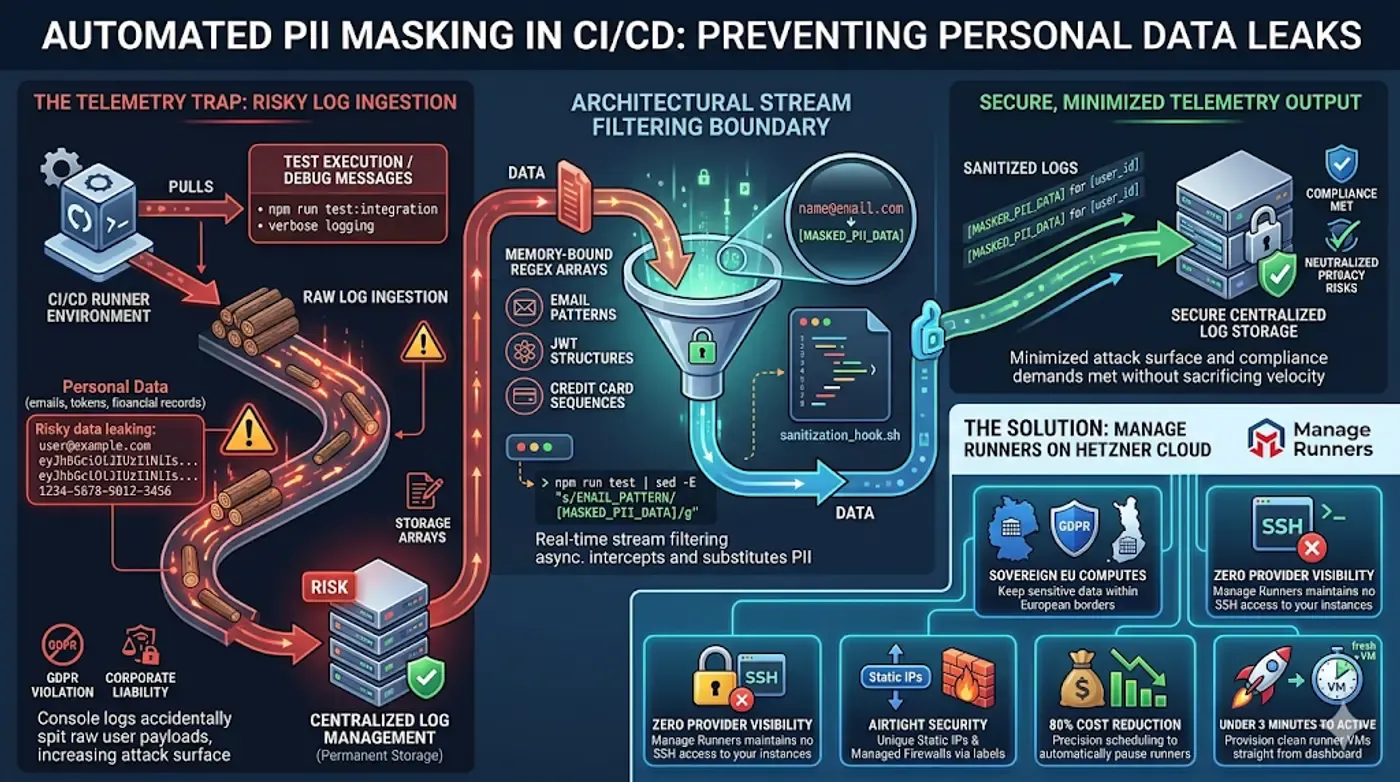
In the modern DevSecOps pipeline, log files are invaluable for debugging compilation faults and monitoring deployment statuses. However, they also represent a severe corporate liability. When testing applications with realistic datasets, automated test suites and verbose debug steps can accidentally spit personal data such as user emails, session tokens, and financial records—directly into standard output streams. Implementing strict data minimization mandates that your infrastructure actively strips this sensitive metadata at the execution boundary. By enforcing automated PII masking inside your runner environments, you neutralize privacy risks before they migrate into persistent third-party log management systems.
1. The Risk Profile of Raw Log Ingestion
Continuous integration servers are incredibly efficient at capturing and forwarding runtime details. Unfortunately, this unselective capture mechanism exposes organizations to regulatory breaches under frameworks like GDPR.
When runtime exceptions trace back through database queries, the resulting debug blocks often print entire raw object payloads to the console. If these console logs are automatically aggregated by global tracking platforms, your transient build data becomes permanently recorded across external storage clusters, increasing your potential attack surface.
2. Architectural Mechanics of Stream Filtering
To apply effective data minimization, teams must intercept raw console streams asynchronously. Relying on engineers to manually sanitize application code is a fragile security model. Instead, your infrastructure layout must process log buffers through real-time stream filters.
An optimized architecture hooks into the runner's stdout/stderr interface, streaming log output through memory-bound regular expression (regex) arrays. This design allows you to match and mask specific text patterns (such as standard JWT structures, credit card sequences, and email strings) while preserving the surrounding system messages required for operational debugging.
3. Engineering Blueprint: Active Log Sanitization
You can implement programmatic PII masking by placing a lightweight processing wrapper directly around your pipeline's primary test execution steps:
#!/bin/bash
# High-Performance Log Stream Interceptor Hook
# Intercepts console output to sanitize personal patterns in real time

# Define sensitive target patterns (e.g., standard email regex)
EMAIL_PATTERN="[a-zA-Z0-9._%+-]+@[a-zA-Z0-9.-]+\.[a-zA-Z]{2,}"

# Execute application tests and run inline substitution before logging
npm run test:integration 2>&1 | sed -E "s/$EMAIL_PATTERN/[MASKED_PII_DATA]/g"

echo "Stream validation successful: Outbound logs sanitized securely."
Utilizing streaming utility hooks like sed or custom memory pipes ensures the transformation occurs entirely within the active computing memory, preventing plain-text personal data from ever writing to persistent log storage volumes.4. Manage Runners: Sovereign Infrastructure Built for Data Privacy
Enforcing complex data filtering policies manually across distributed, unmanaged build clusters generates significant DevOps maintenance toil. Manage Runners provides a centralized, automated platform to launch and orchestrate high-performance GitLab runners on Hetzner Cloud, offering the ideal physical boundary for private data control.
Our platform supports strict information defense through isolation:
- Sovereign EU Computes: All build nodes host safely inside your own GDPR-compliant Hetzner account across premier data centers in Germany and Finland, keeping sensitive data within European borders.
- Zero Provider Visibility: For total system autonomy and code protection, Manage Runners maintains no SSH access to your runner instances, keeping you in absolute control of your execution setups.
- Under 3 Minutes to Active: Dynamically provision clean runner VMs straight from our modern interface, executing every job block on a clean "blank slate" to avoid persistent storage clutter.
- Airtight Network Boundaries: Every automated node receives a unique Static IP address and automated Hetzner Firewalls managed via labels to protect your resource perimeters during deployment tasks.
By running your optimized pipelines on dedicated Hetzner instances and utilizing our native precision scheduling to automatically pause runners when developers are offline, engineering teams routinely cut standard managed infrastructure spend by up to 80% while establishing an uncompromised foundation for data privacy.
5. Conclusion
Console logs shouldn't double as data leakage paths. By coupling programmatic masking filters with the secure, automated compute isolation provided by Manage Runners, you satisfy modern data minimization compliance demands without sacrificing development or debugging velocity.
Ready to secure your pipeline telemetry? [Optimize your Log Security with Manage Runners] and experience automated runner control on Hetzner Cloud.