In 2026, the CI/CD pipeline is the literal heartbeat of software delivery, yet it remains one of the most overlooked surfaces for intellectual property theft. As supply chain attacks become more sophisticated, build runners have emerged as a prime target for sensitive data harvesting. Protecting your source code requires moving beyond simple "secrets management" to a proactive stance on infrastructure security, ensuring that the environment where your code is compiled is not a gateway for illicit data removal.
1. The Anatomy of a Leak: What is Data Exfiltration?
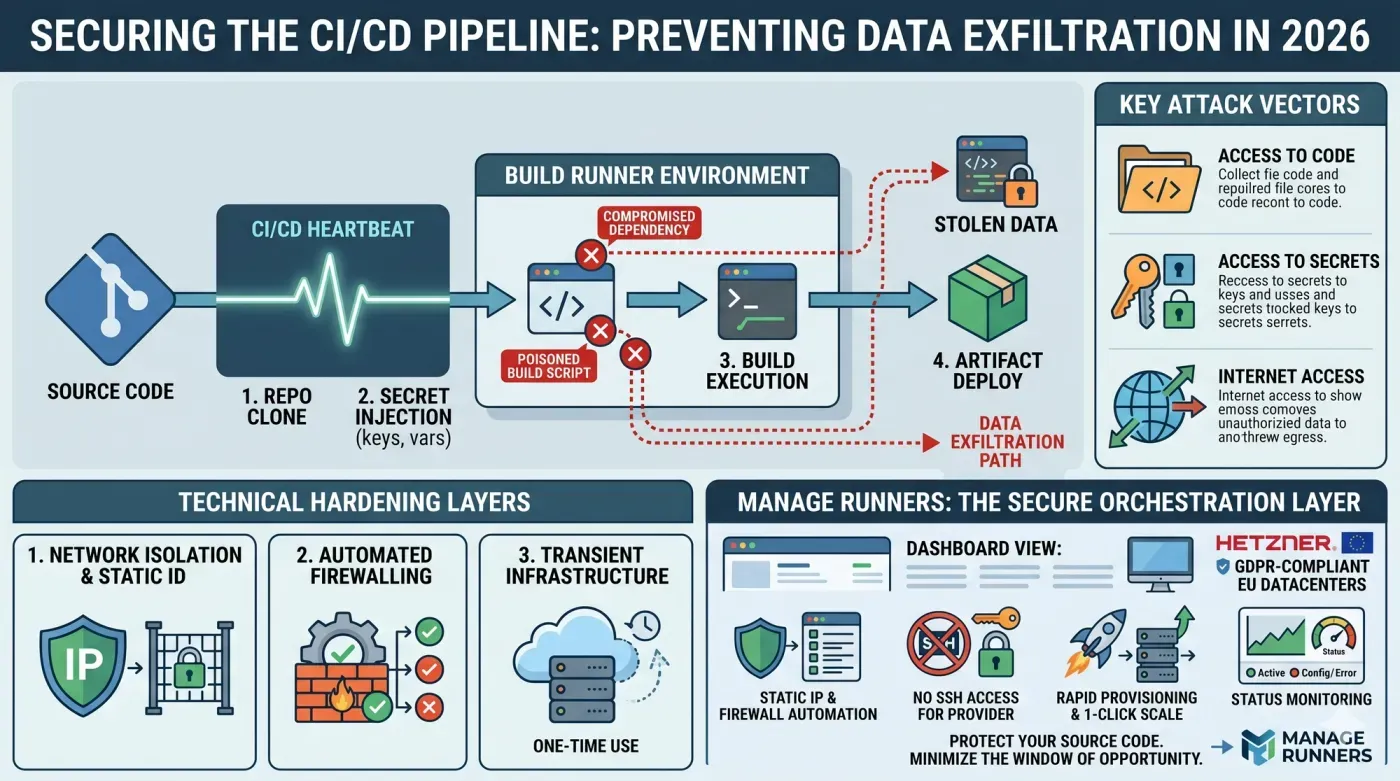
In the context of modern DevOps, the data exfiltration meaning refers to the unauthorized transfer of sensitive information from your build environment to an external, attacker-controlled destination. While many focus on database breaches, CI/CD data exfiltration often occurs via compromised dependencies or "poisoned" build scripts that silently "phone home" environment variables, private keys, or the raw source code itself during a build job.
2. The Build Runner as a High-Value Target
Why do attackers target runners? Because they sit at a unique intersection of access:
- Access to Code: The runner clones the entire repository to execute tasks.
- Access to Secrets: Environment variables (AWS keys, Docker registry credentials) are injected into the runner.
- Access to the Internet: Many default configurations allow runners unrestricted outbound traffic to download dependencies, which also serves as a perfect exit route for stolen data.
3. Technical Hardening: Breaking the Exfiltration Path
Preventing data exfiltration requires a "Zero Trust" approach to your infrastructure. Professional-grade security involves three layers:
Network Isolation and Deterministic Identity
By utilizing Static IP addresses, you can move away from the "open internet" model. A static identity allows you to whitelist your runners at the firewall level, ensuring they only communicate with approved container registries or internal deployment targets.
Automated Firewalling
Managing firewalls manually across 50 runners is a recipe for human error. Security-conscious teams use infrastructure labels to automatically assign firewall rules that block all non-essential outbound ports (e.g., blocking everything except HTTPS to specific domains).
Transient Infrastructure
The longer a runner exists, the higher the risk. Modern security standard operating procedures (SOPs) dictate using transient runners that are provisioned for a task and destroyed immediately after, minimizing the window of opportunity for an attacker to establish a persistent "foothold."
4. Manage Runners: Secure-by-Design Orchestration
Manage Runners was engineered to eliminate the "manual toil" and security debt associated with self-hosted runners on Hetzner Cloud. We provide the orchestration layer that makes data exfiltration prevention a default state, not a post-audit fix.
- Static IP and Firewall Automation: Every runner provisioned via Manage Runners receives a Static IP address. You can automatically assign Hetzner Firewalls to your runners simply by assigning labels within our dashboard, effectively siloing your build environment.
- No SSH Access for the Provider: To ensure total privacy and data sovereignty, Manage Runners has no SSH access to your runner VMs. Your source code and secrets stay within your own Hetzner account, protected by GDPR-compliant EU data centers.
- Rapid Provisioning & Lifecycle: Spin up a hardened, secure runner in less than 3 minutes. Our 1-click duplication allows you to scale verified security configurations across your entire fleet instantly.
- Status Monitoring: Track your runner's status (Active, Configuring, Error) in real-time, allowing you to catch and "Fix" deployment issues before they become security vulnerabilities.
By paying Hetzner directly for the compute and using Manage Runners for orchestration, you reclaim up to 80% of your CI/CD budget while gaining a significantly more secure posture against Data exfiltration.
5. Conclusion
Source code is your organization’s most valuable asset. By understanding the data exfiltration meaning and implementing hardened, automated infrastructure, you ensure your pipeline remains a closed loop of innovation.
Ready to secure your build fleet? [Experience Secure Runner Orchestration with Manage Runners] and build with total confidence on Hetzner Cloud.