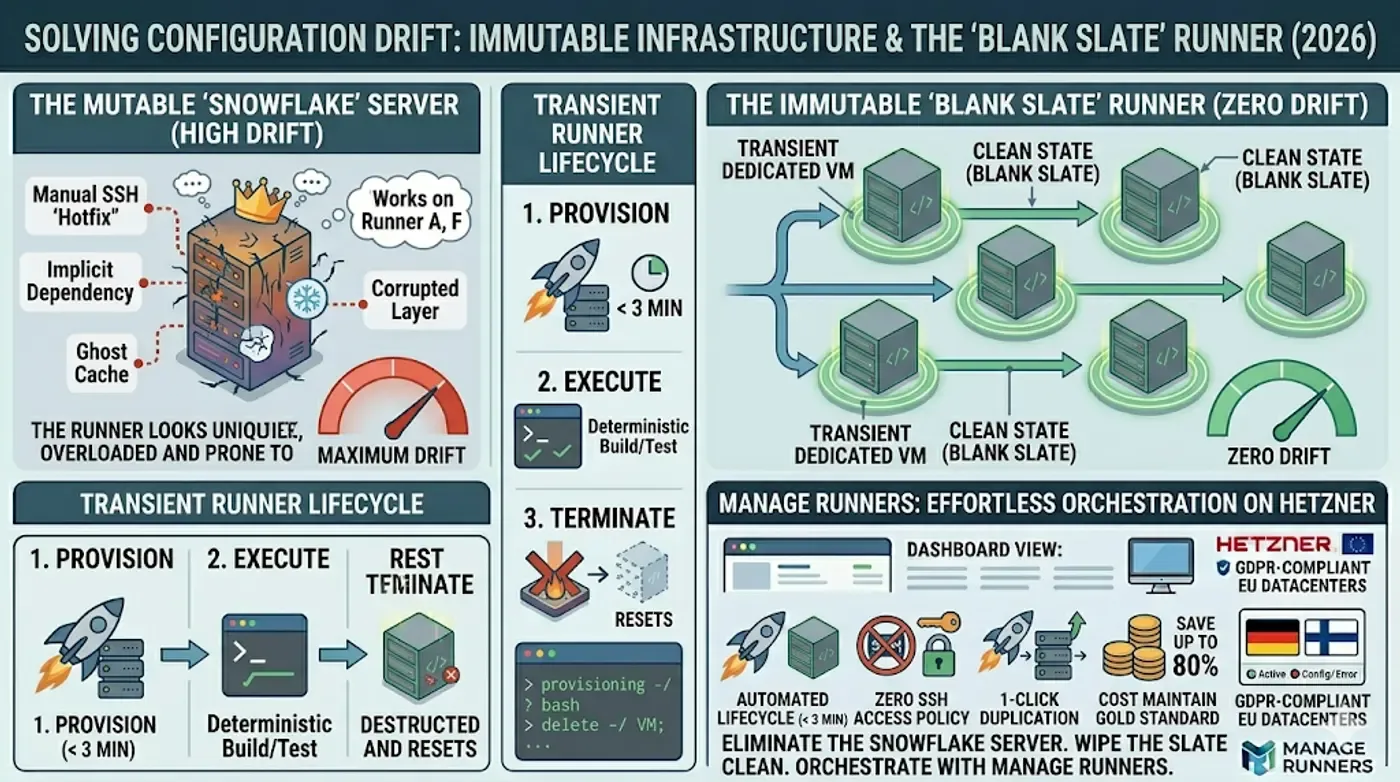
In the world of DevOps, a "Snowflake Server" is a unique, delicately configured machine that no one dares to touch for fear of breaking the build. These servers are the antithesis of modern scaling. To achieve true reliability in 2026, teams must embrace immutable infrastructure a philosophy where runners are never modified after deployment. Instead, every build starts with a "blank slate." This approach is the only definitive way to eliminate configuration drift, ensuring that your pipeline remains predictable, secure, and infinitely scalable.
1. Mutable vs. Immutable: The Technical Divide
Traditional CI/CD runners are often "mutable." They stay active for months, accumulating local caches, updated packages, and manual hotfixes. Over time, these runners become "Snowflakes."
Immutable Infrastructure changes the paradigm:
- Mutable: You update the runner in place. Result: Configuration Drift.
- Immutable: You replace the runner entirely for new requirements. Result: Deterministic builds.
2. Configuration Drift: The Silent CI/CD Killer
Configuration drift occurs when the actual state of a runner diverges from its intended configuration (defined in your IaC). This is usually caused by:
- Manual SSH "Hotfixes": An engineer logs in to fix a dependency, forgetting to update the setup script.
- Implicit Dependencies: A build succeeds only because a previous job left a specific library in the
/tmpfolder. - Ghost Caches: Corrupted Docker layers or build artifacts that persist across jobs.
When drift occurs, you face the "It works on Runner A but fails on Runner B" nightmare. By treating infrastructure as immutable, you ensure that every runner is a bit-for-bit match of your gold standard.
3. Implementing the "Blank Slate" Strategy
To kill the Snowflake Server, your runners must be transient. The workflow follows a strict lifecycle:
- Provision: Spin up a fresh VM based on a pre-defined image.
- Execute: Run the build/test suite.
- Terminate: Destroy the VM immediately.
# Example: Conceptual workflow for an Immutable Runner
# 1. Define the 'Gold Image'
IMAGE_ID="ubuntu-22-04-lts-hardened"

# 2. Provision a transient node (using Hetzner CLI as an example)
hcloud server create --name "runner-$(date +%s)" --image "$IMAGE_ID" --type "cax11"

# 3. After build completion, the orchestrator triggers destruction
hcloud server delete "runner-node-id"
4. Manage Runners: Effortless Immutability on Hetzner
Managing the lifecycle of immutable runners manually is a massive operational burden. Manage Runners was designed to provide the benefits of immutable infrastructure without the DevOps "toil."
We provide a centralized dashboard to manage your entire runner fleet on Hetzner Cloud, ensuring you never have to deal with a Snowflake Server again:
- Provision in < 3 Minutes: Our automation spins up fresh, hardened runners on Hetzner Cloud instantly, ensuring every job starts on a clean slate.
- 1-Click Duplication: Found the perfect configuration? Clone it across your entire fleet to maintain zero Configuration Drift.
- Zero SSH Access Policy: To guarantee immutability, Manage Runners does not have SSH access to your VMs. This forces a "deploy-new-not-fix-old" culture that is fundamentally more secure.
- Cost Efficiency: By combining transient runners with our Precision Scheduling, teams save up to 80% on CI/CD costs compared to managed providers.
- EU Sovereignty: All runners are hosted in your own Hetzner account (Germany/Finland), keeping your data GDPR-compliant and sovereign.
5. Conclusion
The era of the Snowflake Server is over. By adopting Immutable Infrastructure and leveraging the automated orchestration of Manage Runners, you turn your CI/CD from a source of anxiety into a high-performance engine of consistency.
Ready to wipe the slate clean? [Experience Immutable CI/CD with Manage Runners] and scale your infrastructure on Hetzner Cloud with total confidence.