In the 2026 DevOps landscape, relying on shared, throttled managed environments often leads to pipeline congestion. For teams requiring dedicated performance and data sovereignty, a virtual private server (VPS) is the gold standard for self-hosted runners. However, finding the best VPS hosting isn't just about price it’s about compute density, network throughput, and the ability to automate lifecycle management without manual "toil."
1. Why a Virtual Private Server is Essential for CI/CD
Modern CI/CD workloads especially those involving heavy containerization or complex integration tests require consistent CPU and I/O performance. A Virtual private server offers dedicated resources that managed services often lack. By self-hosting, teams gain:
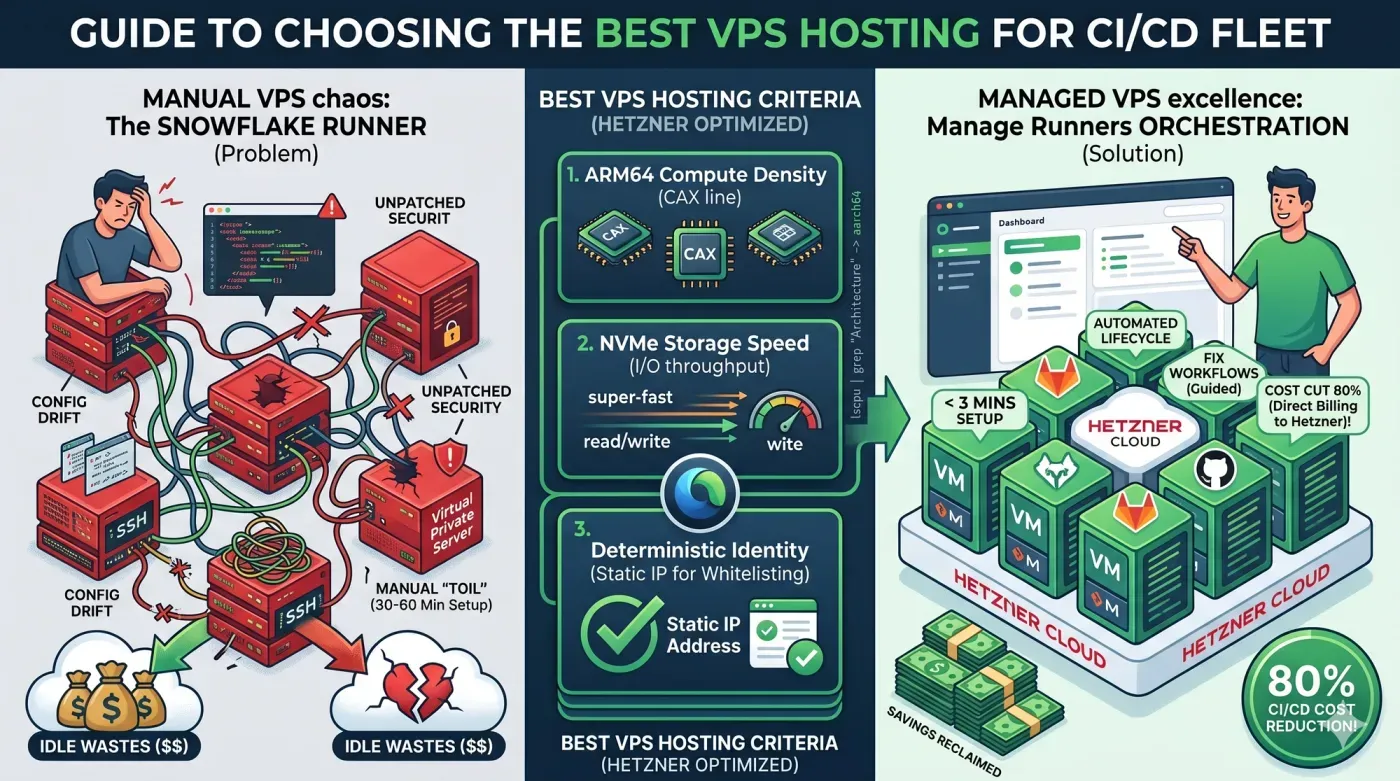
- Architectural Flexibility: Choose between x86 or ARM64 (like Hetzner CAX line) to match production environments.
- Enhanced Security: Keep build artifacts and secrets within your own private network.
- Reduced Latency: Host runners in the same geographic region as your primary data.
2. Technical Criteria for the Best VPS Hosting
When evaluating providers, don't just look at vCPU counts. For a runner-optimized environment, focus on:
- Disk I/O: NVMe-backed storage is a requirement to prevent Docker image layer extraction from becoming a bottleneck.
- Compute Performance: Prioritize dedicated cores over shared "burstable" instances to avoid steal time during peak build hours.
- Network Connectivity: High-bandwidth, low-latency links to your Git provider (GitLab/GitHub) are crucial for fast artifact uploads.
# Example: Testing Disk I/O performance on your new VPS
# A high-performance runner host should show high write speeds
dd if=/dev/zero of=testfile bs=1G count=1 oflag=dsync
# Monitoring CPU Steal time during a build
top -bn1 | grep "Cpu(s)" | sed "s/.*, *\([0-9.]*\)%st.*/\1/"
3. The Challenge of Manual VPS Management
Even with the best VPS hosting, manual management is a scaling bottleneck. Hardening the OS, installing Docker, and registering runners via SSH takes 30–60 minutes per node. Furthermore, you often pay for 24/7 uptime even if your team only pushes code during business hours, leading to significant financial waste.
4. Manage Runners: The Effortless Orchestration Layer
Manage Runners transforms any Hetzner-based virtual private server into a high-performance, automated CI/CD engine. We provide the control plane that eliminates the complexity of manual setup.
| Feature | Manual VPS Setup | With Manage Runners |
|---|---|---|
| Setup Speed | 30 - 60 Minutes | < 3 Minutes |
| Maintenance | Manual SSH Patching | Automated & Updated |
| Security | Manual Firewalling | Hetzner Firewall Labels |
| IP Management | Dynamic/Manual | Static IP Address |
By using Manage Runners, you leverage the best VPS hosting on Hetzner Cloud while reducing your CI/CD costs by up to 80%. Our platform allows you to:
- Schedule Runners: Automatically start/stop instances to save costs during idle periods.
- Maintain Security: We provide Static IP addresses for whitelisting and ensure we have no SSH access to your VMs, keeping you GDPR compliant.
- Scale Instantly: Use 1-click duplication to clone runner configurations across your fleet.
5. Conclusion
Transitioning to a virtual private server for your build fleet is the first step toward DevOps maturity. By pairing high-performance hardware with the automation of Manage Runners, you ensure your pipeline is fast, secure, and cost-efficient.
Ready to build a better pipeline? [Start your High-Performance VPS journey with Manage Runners] and experience effortless runner orchestration.