In 2026, maintaining structural parity between your container orchestration layers and your host operating system is a non-negotiable security baseline. Many enterprise DevOps teams routinely update their application images and Docker engines while neglecting the underlying host platform. Running modern container runtimes like Docker v26+ on an obsolete linux operating system distribution creates a silent, dangerous technical friction. This mismatch compromises system call filters and namespace boundaries, exposing your entire build infrastructure to severe execution vulnerabilities.
1. The Syscall Mismatch in Modern Container Runtimes
The foundational architecture of containerization relies on shared kernel primitives. A container does not possess its own kernel; it routes instructions directly to the host operating system.
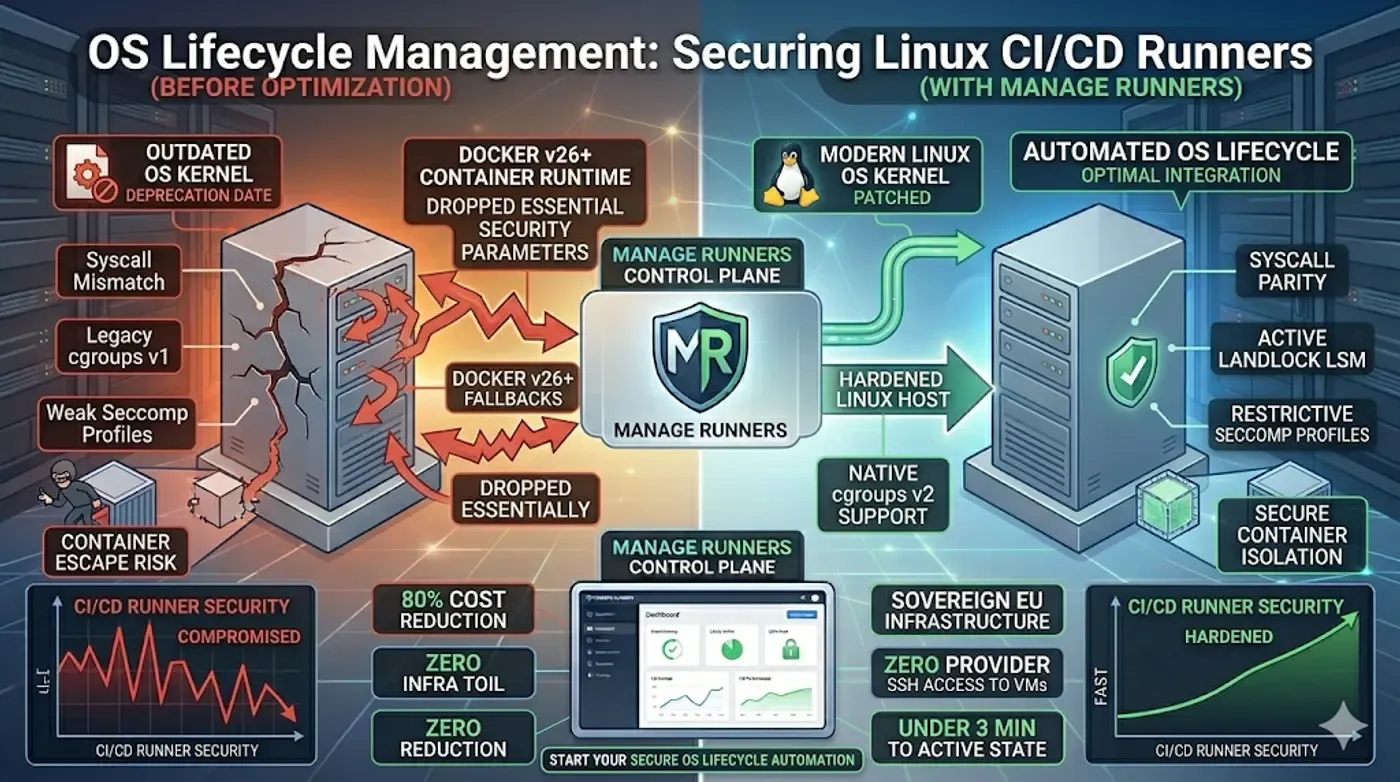
When modern container runtimes (such as Docker v26+ utilizing updated components of containerd and runc) execute inside an antiquated host environment, compatibility routines break down. Modern container engines expect updated system configurations, native cgroups v2 resource structures, and recent kernel patches (such as clone3 or advanced landlock LSM architectures). If the underlying host kernel is deprecated, the runtime is forced into fallback architectures, dropping essential security parameters without alerting the system administrator.
2. The Danger of Container Escape and Stale Seccomp Profiles
The most significant operational vulnerability exposed by unmanaged linux operating system life cycles is container escape. Security filters like Seccomp (Secure Computing Mode) map out exactly which instructions a system container can send to the host CPU.
An outdated host lacks the architectural mechanisms to parse modern, restrictive seccomp profiles correctly. If a malicious third-party library or package dependency is downloaded during a standard build pipeline step, it can exploit these structural omissions. By bypassing weak cgroup boundaries, an attacker can move laterally out of the containerized workspace straight into the host architecture, exposing repository secrets, environment tokens, and network access points.
3. Auditing Your Build Node Compliance
To ensure your automated pipelines are running on an uncompromised framework, platform engineers must programmatically audit their host nodes. Running out-of-date LTS distributions introduces systemic risk into your deployment fleet.
# Verify host kernel release and cgroup version compatibility
echo "=== Host Kernel Architecture ==="
uname -mrs

echo "=== Evaluating Unified Control Groups (cgroups v2) ==="
if [ -f /sys/fs/cgroup/cgroup.controllers ]; then
    echo "Compliant: Native cgroups v2 enabled."
else
    echo "VULNERABILITY RISK: Legacy cgroups v1 detected on this operating system."
fi
4. Manage Runners: Automated, Modern Infrastructure for GitLab
Manually keeping pace with upstream operating system lifecycles while managing complex build infrastructure causes massive operational friction. Manage Runners provides a centralized platform built to automate the provisioning, tracking, and maintenance of hardened GitLab runners on Hetzner Cloud.
Our platform eliminates the risks of stale host architectures by transforming your build environment into a clean, modern compute facility:
- Instant Clean Provisioning: Spin up identical, fully updated runner virtual machines in under 3 minutes straight from a centralized dashboard. Each job executes on a secure "blank slate."
- Hardened Security Boundaries: Automatically assign Hetzner Firewalls to your instances by simply applying infrastructure labels directly through our interface.
- Network Identity Control: Every runner receives a dedicated Static IP address, giving your security team the ability to lock down internal target environments securely.
- Absolute Code Privacy: Built to be fully GDPR compliant, your workloads execute safely inside your own EU-based Hetzner account (Germany/Finland). Crucially, Manage Runners maintains no SSH access to your runner VMs, ensuring your source code remains truly sovereign.
By pairing modern, high-performance compute with our native precision scheduling which automatically sleeps idle resources to reduce infrastructure costs by up to 80% you can completely discard the maintenance burden of legacy system configurations.
5. Conclusion
An unpatched base platform undermines even the most rigorous application security scanning. By synchronizing your underlying linux operating system lifecycle with your modern container workflows, you eliminate silent isolation vulnerabilities and build an uncompromised path toward secure delivery.
Ready to secure your host layer? [Deploy modern, hardened runners with Manage Runners] and achieve effortless infrastructure automation on Hetzner Cloud.