In distributed computing, the simplest algorithm is often a hidden architectural trap. Many infrastructure teams rely on basic First-In, First-Out (FIFO) queues for continuous integration. While FIFO appears equitable on paper, it completely collapses under synchronized corporate schedules. When multiple developers trigger pipelines simultaneously, legacy job scheduling models trigger the thundering herd problem, inducing catastrophic local outages across container registries and internal backend coordination paths.
1. The Fallacy of Naive FIFO Queues
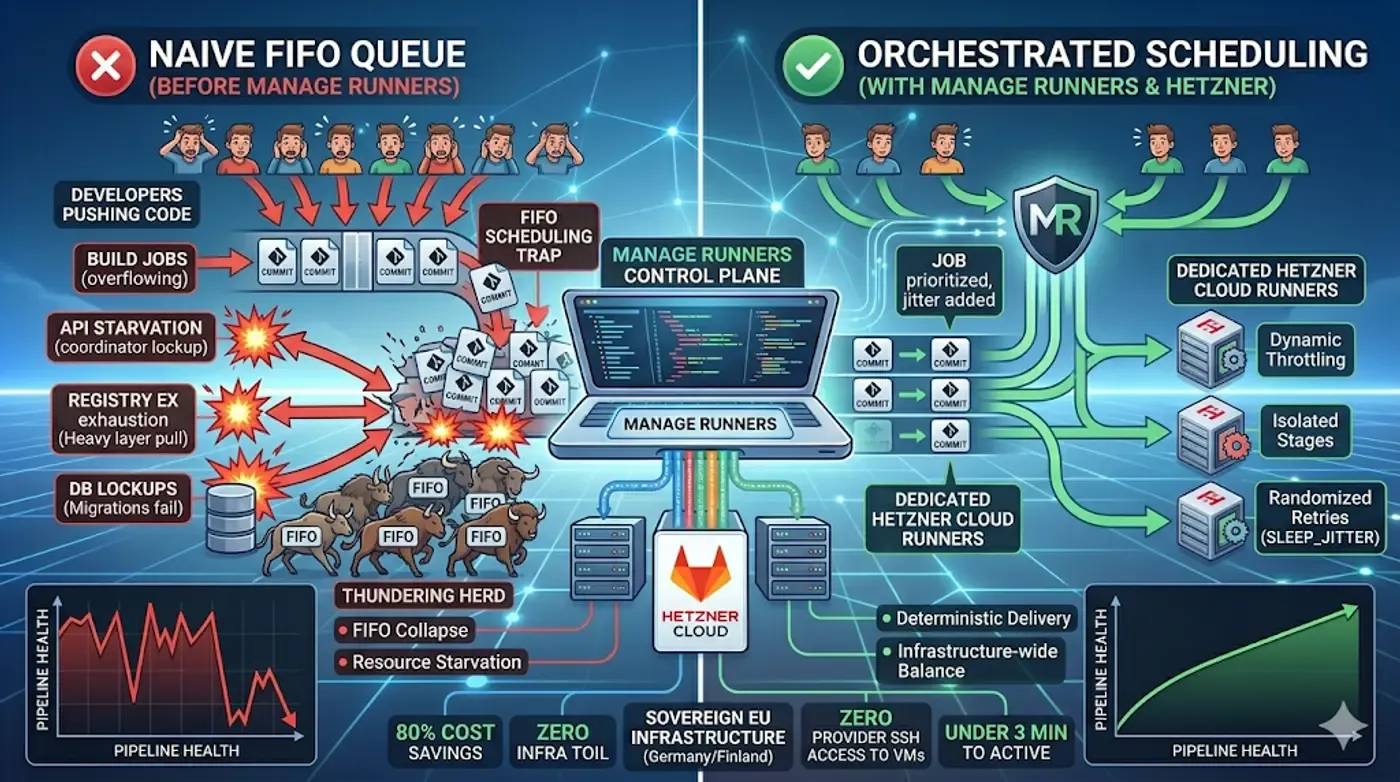
FIFO assumes a uniform distribution of tasks over time. In reality, software engineering teams push code in intense bursts right before lunch, at the end of a sprint, or via automated night-shift cron cycles. A naive queue stacks these jobs sequentially, but if the processing fleet scales up too rapidly without backoff jitter, a mass of compute nodes requests assets simultaneously. This lack of prioritization transforms a brief queue spike into an infrastructure-wide resource block.
2. The Mechanics of the Thundering Herd
The thundering herd problem occurs when a single event wakes up a vast flock of resource consumers, but only one can claim the target while the rest overwhelm the system. In a CI/CD context, when a long-running global pipeline blocker clears, dozens of idle runners poll the coordinator at microsecond intervals.
This severe coordination surge creates predictable system failures:
- API Starvation: The main Git server is bombarded with token validation and status synchronization calls.
- Registry Exhaustion: Hundreds of automated nodes attempt to pull heavy base Docker layers at the same microsecond, hitting rate limits or disk I/O limits.
- Database Lockups: Concurrent deployment migrations running on parallel runners attempt to read or modify identical tables simultaneously.
3. Mitigating Queue Congestion with Traffic Shaping
Resolving this scheduling gridlock requires programmatic traffic shaping. Pipelines require explicit execution specifications, dynamic throttling, and randomized retry intervals to break up synchronization blocks.
# Implementing random jitter in runner orchestration scripts
# This prevents synchronized runners from polling the coordinator simultaneously
SLEEP_JITTER=$(shuf -i 1-15 -n 1)
echo "Jitter enabled. Deliberately delaying execution by $SLEEP_JITTER seconds..."
sleep $SLEEP_JITTER

# Initialize runner execution step
gitlab-runner run --working-directory=/home/gitlab-runner
4. Manage Runners: Deterministic Fleet Control
Orchestrating a balanced, storm-resistant build fleet manually presents major DevOps hurdles. Manage Runners provides an elegant control plane to deploy and manage isolated GitLab runners on Hetzner Cloud without the structural chaos.
Instead of grouping jobs into a single fragile environment, our dashboard lets you spin up dedicated, highly responsive runners in under 3 minutes. With features like 1-click scaling and customizable execution specifications, you can isolate high-impact build stages instantly. Every node operates with a unique Static IP address and programmatically assigned Hetzner Firewalls via labels to protect your internal resources during deployment peaks.
By utilizing our native precision scheduling to curb off-hour resource spikes and paying Hetzner directly for compute with zero markup, teams routinely experience an 80% reduction in CI/CD infrastructure costs. For absolute code privacy, Manage Runners maintains no SSH access to your runner VMs.
5. Conclusion
Relying on legacy queue models invites systemic fragility into your deployment pipeline. Transitioning to a distributed, well-orchestrated runner architecture removes resource contention and guarantees your automated pipelines remain operational under maximum engineering load.
Ready to immunize your build fleet against concurrency storms? [Secure your Job Scheduling with Manage Runners] and experience automated, predictable delivery on Hetzner Cloud.