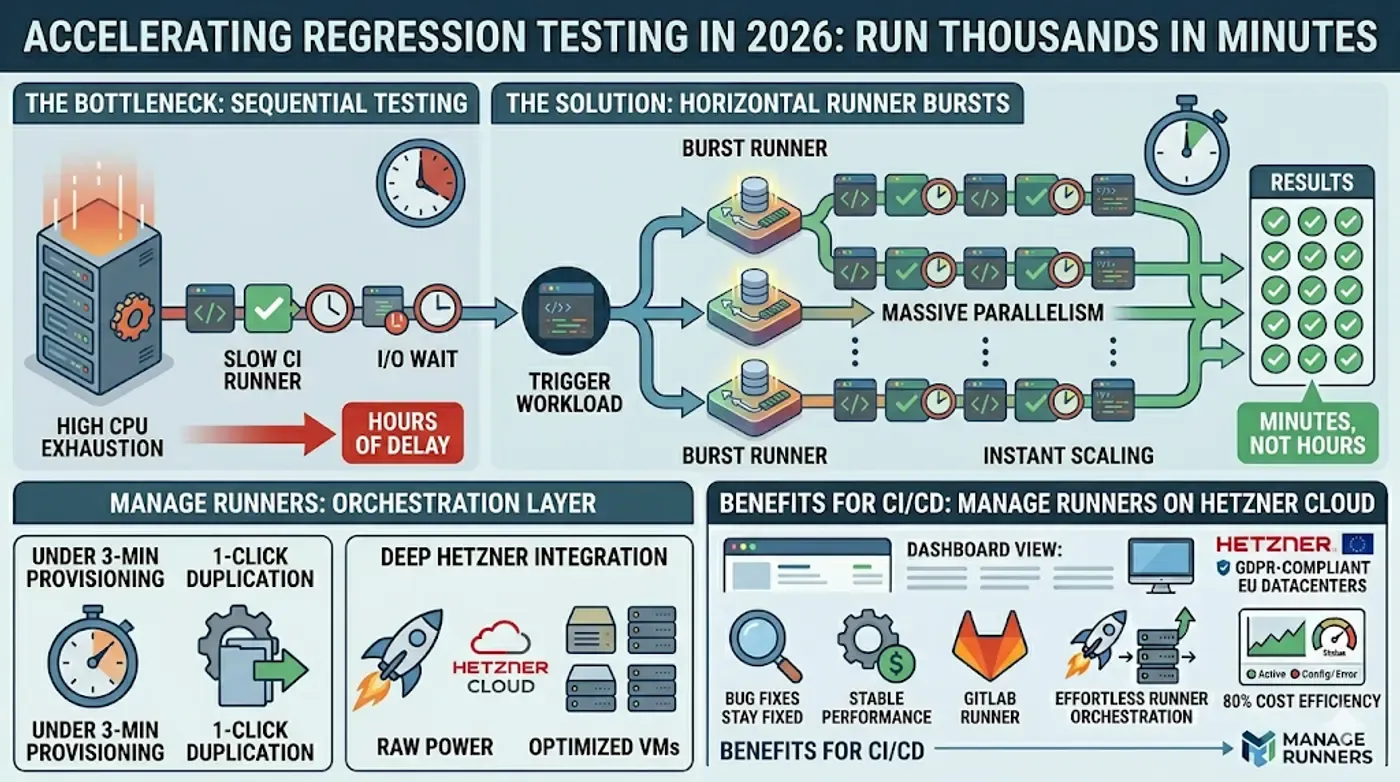
In 2026, the speed of your feedback loop defines the speed of your business. As codebases grow in complexity, regression testing becomes the ultimate safeguard against "breaking the past" while building the future. However, for many teams, the sheer volume of tests creates a bottleneck that delays releases. To maintain agility, organizations must shift from legacy, sequential testing to a model of massive parallelism, where thousands of tests are executed simultaneously across a scalable runner fleet.
1. The Bottleneck: What is Regression Testing in the Modern Era?
To solve the scaling issue, we must first address what is regression testing in a continuous delivery context. It is the process of re-running functional and non-functional tests to ensure that a recent code change hasn't adversely affected existing features.
The problem? As your application matures, your regression suite naturally expands. What started as a 5-minute check grows into a 2-hour marathon. When tests take hours, developers stop running them frequently, leading to "integration hell" and a sharp decline in software quality.
2. The Solution: Massive Parallelism and Execution Specs
The only way to run thousands of tests in minutes is to break the suite into hundreds of parallel chunks. This requires an infrastructure capable of:
- Horizontal Scalability: Provisioning 50+ runners instantly as a pipeline triggers.
- High-Compute Density: Utilizing optimized CPU architectures (like ARM64) to handle intense testing logic without thermal throttling.
- Standardized Environments: Ensuring every runner is an exact clone to avoid "flaky tests" caused by environmental discrepancies.
# Example: Using GitLab Parallelism for Regression Suites
# This distributes tests across 20 parallel runner instances
regression_job:
  parallel: 20
  script:
    - ./run_parallel_tests.sh --chunk=$CI_NODE_INDEX --total=$CI_NODE_TOTAL
3. Optimizing Infrastructure for Test Speed
Software quality is limited by hardware performance. For regression testing, I/O speed and CPU concurrency are the primary levers. By moving away from shared cloud instances to dedicated virtual resources on providers like Hetzner, teams can reduce test execution time by 40–60% simply through better hardware utilization and NVMe storage speeds.
4. Manage Runners: Instant Scalability for Test Suites
Manage Runners is the orchestration layer designed to make high-volume regression testing effortless and cost-effective. We enable DevOps teams to leverage the power of Hetzner Cloud with a centralized management dashboard.
- Provisioning in < 3 Minutes: Need 10 extra runners for a massive release? Spin them up instantly with customizable execution specifications to match your testing requirements.
- 1-Click Duplication: Ensure 100% parity across your testing fleet. Duplicate verified configurations to scale your parallelism without manual "toil."
- Hetzner Optimization: We are specifically tuned for Hetzner's high-performance VMs. By paying Hetzner directly for the compute, you reclaim up to 80% of your CI/CD budget.
- Security & Sovereignty: Our platform is GDPR compliant. We have no SSH access to your VMs, and your runners are hosted in your own EU-based account (Germany/Finland), keeping your proprietary test data secure.
Manage Runners handles the lifecycle management including automated "Fix" workflows so your SREs can focus on reliability while your developers focus on code.
5. Conclusion
Scaling your quality assurance shouldn't break your budget or your timeline. By understanding what is regression testing at scale and implementing a highly parallelized infrastructure, you ensure that your project is never held back by its own success.
Ready to run your entire test suite in minutes? [Experience instant scalability with Manage Runners] and build a faster, more resilient release engine.