In the 2026 DevOps landscape, software delivery velocity is heavily dictated by pipeline design. Traditional linear, stage-based CI/CD architectures frequently introduce structural delays because fast, independent tasks are forced to wait for slow, unrelated workloads to conclude. Transitioning to modern workflow automation tools allows platform engineers to model deployment pipelines using a directed acyclic graph (DAG). By organizing dependencies directly at the job layer, teams can separate tasks with fundamentally different attributes from the sequential flow, significantly reducing total pipeline runtimes.
1. The Bottleneck of Rigid Sequential Pipelines
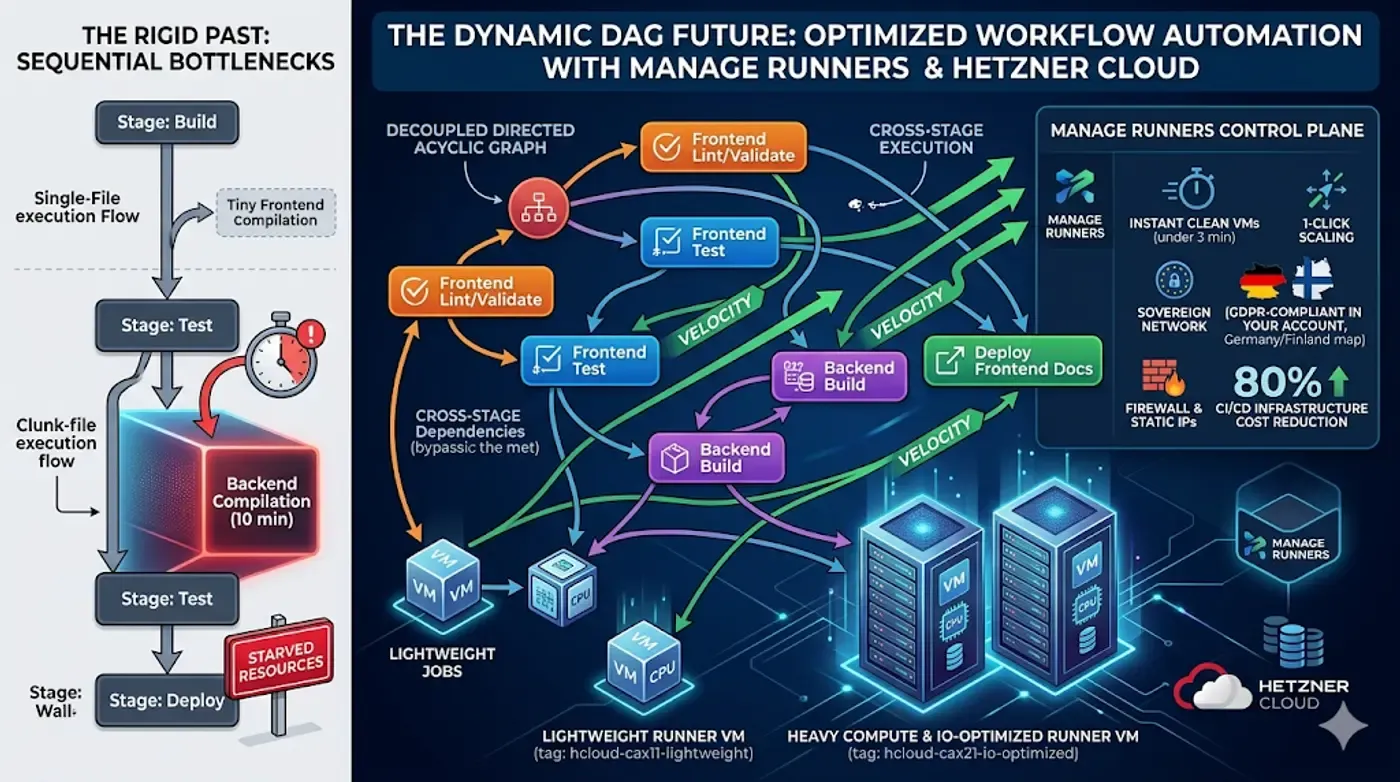
Standard linear pipelines group jobs strictly into sequential brackets (e.g., Build, Test, Deploy). Under this model, no job in the Test stage can execute until every single component of the Build stage finishes. If a lightweight frontend compilation takes 30 seconds, but a legacy backend build takes 10 minutes, your frontend testing suites sit entirely idle. This structural limitation creates artificial queues, starves high-performance computing resources, and extends developer feedback loops unnecessarily.
2. Decoupling Workloads via a Directed Acyclic Graph (DAG)
A directed acyclic graph resolves this gridlock by establishing explicit parent-child relationships between individual jobs, completely bypassing rigid stage walls.
When a pipeline is modeled as a DAG, a job executes the exact millisecond its declared prerequisites are met. For example, a documentation deployment task can fire immediately after the markdown validation step concludes, completely ignoring the status of parallel integration testing tracks. This cross-stage execution path optimizes hardware utilization and maximizes parallel output across your build farm.
3. Configuring Runner Attributes for Heterogeneous Workloads
Isolating execution paths via a DAG is only half the battle; the underlying hardware must also be optimized for the specific task attributes. Lightweight linters should not run on the same expensive, high-concurrency instances required by deep machine learning tests or massive compilation tasks. By mapping unique job constraints to targeted runner tags, you ensure efficient infrastructure distribution:
# Advanced DAG Configuration Blueprint
# Bypassing stage walls while matching task attributes to runner hardware
validate_frontend_assets:
  stage: build
  tags:
    - hcloud-cax11-lightweight
  script:
    - npm run lint

test_frontend_code:
  stage: test
  needs: ["validate_frontend_assets"]
  tags:
    - hcloud-cax21-io-optimized
  script:
    - npm run test:unit
4. Manage Runners: Effortless Infrastructure for Complex DAG Workloads
Orchestrating a highly parallelized, multi-attribute runner fleet manually introduces severe administrative toil. Manage Runners provides a centralized, automated platform to deploy and manage high-performance GitLab runners on Hetzner Cloud, offering the ideal compute engine for intricate DAG architectures.
Our control plane abstracts the infrastructure complexity, allowing your engineering teams to focus purely on workflow efficiency:
- Under 3 Minutes to Active State: Instantly spin up clean, dedicated runner virtual machines tailored with custom execution specifications (Docker, Docker-In-Docker, or Shell).
- 1-Click Scaling Configurations: Found the perfect hardware profile for a heavy dependency branch in your directed acyclic graph? Duplicate that exact runner environment effortlessly straight from our interface.
- Sovereign Network Foundations: All instances reside safely within your own GDPR-compliant Hetzner account (Germany/Finland). For total source-code isolation, Manage Runners maintains no SSH access to your runner VMs.
- Hardened Security & Identity: Protect your build nodes with automated Hetzner Firewalls mapped via labels, and utilize unique Static IP addresses to securely whitelist your deployment destinations.
By running your optimized pipelines on dedicated, unthrottled hardware and leveraging our precision scheduling to sleep runners during idle off-hours, teams regularly experience an 80% reduction in CI/CD infrastructure costs.
5. Conclusion
Rigid stage boundaries belong in the past. Embracing advanced workflow automation tools to transition your pipelines into highly parallel execution trees removes compute friction and secures a fast, highly dependable path toward continuous integration.
Ready to unleash true parallel pipeline throughput? [Optimize your Directed Acyclic Graph with Manage Runners] and experience automated fleet management on Hetzner Cloud.