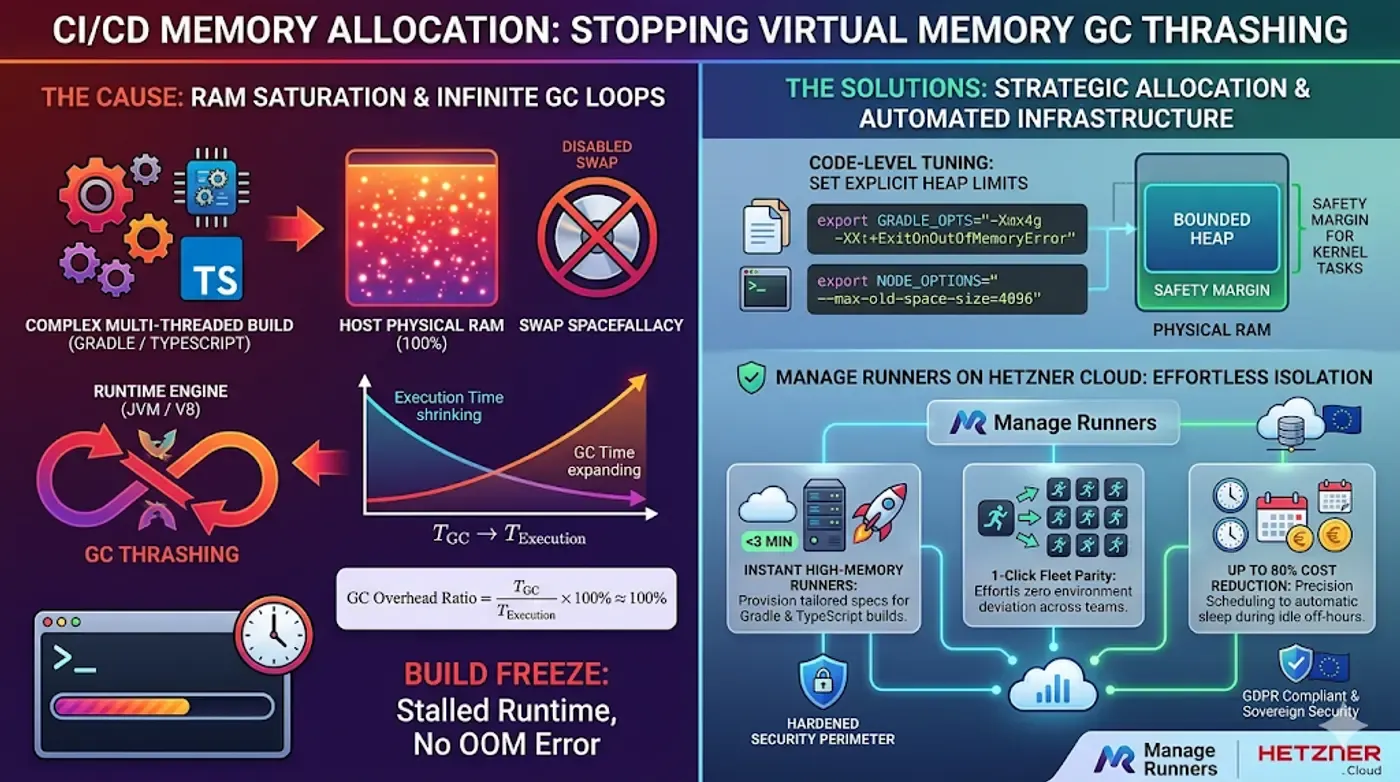
When complex Java (Gradle) or TypeScript (V8 Engine) compilation tasks stall unexpectedly without throwing an Out-Of-Memory (OOM) error, platform engineers often waste hours tracking down phantom integration bugs. The actual culprit is typically a low-level structural conflict inside your host kernel's Memory Management subsystem. Running intensive, multi-threaded compilation pipelines on compute nodes that lack a dedicated swap space forces runtime engines into persistent, resource-draining Garbage Collection loops, quietly crippling your pipeline throughput.
1. The Micro-Mechanics of Garbage Collection Thrashing
During heavy compilation tasks, runtime environments dynamically request large chunks of system RAM for object graph generation and type checking. When physical memory saturates, the runtime’s internal management framework attempts to reclaim unreferenced memory addresses to stay operational.
If the host operating system lacks a backup virtual memory boundary to offload inactive anonymous pages, the runtime falls into an infinite loop known as Garbage Collection (GC) thrashing. The runtime's execution loop can be modeled by analyzing its overall processor utilization:
When the engine spends nearly all available processor cycles () desperately scavenging bytes instead of running compiler code, the progress curve drops to zero. To the developer dashboard, the job appears active, but the underlying execution thread is effectively deadlocked.
2. The Swap Space Fallacy in Stateless Build Farms
A common design pattern in containerized build architectures is disabling swap space entirely to achieve predictable workload pacing. While this restriction makes sense for long-lived, predictable web microservices, it acts as an structural risk factor for spikes in continuous integration pipelines.
Without access to a fallback disk-backed layout, the Linux kernel cannot selectively evict cold, idle page caches or configuration structures to accommodate sudden memory requests. The moment physical allocations peak, the runtime is starved of execution space. It enters an aggressive GC loop right before the kernel's automated OOM defense triggers a hard process termination.
3. Blueprint: Tuning Runtime Allocations for Heavy Compilations
To eliminate these invisible execution freezes, platform teams must introduce explicit maximum heap boundary parameters directly inside pipeline initialization layers, matching application configurations precisely with the physical limits of the runner node:
# Core Configuration Framework: Setting Hard Execution Boundaries
# Explicitly control Memory Allocation to prevent host-level resource contention

# 1. Enforce strict heap limits for Java / Gradle environments
export GRADLE_OPTS="-Xmx4g -Xms1g -XX:+UseG1GC -XX:+ExitOnOutOfMemoryError"

# 2. Restrict the memory footprint of the V8 Node engine during TS compilation
export NODE_OPTIONS="--max-old-space-size=4096"

echo "Initialization complete: Runtime heap parameters bound successfully."
Restricting maximum heap spaces below the host instance's total physical capacity leaves a safety margin for essential kernel tasks, preventing system-wide freezes.
4. Manage Runners: Tailored Memory Architecture on Hetzner Cloud
Manually auditing host resource configurations, configuring proper kernel parameters, and deploying custom execution nodes across distributed testing environments creates intense DevOps toil. Manage Runners provides an automated, streamlined control plane to launch and orchestrate high-performance GitLab runners directly on Hetzner Cloud.
Our dashboard removes the complexity of managing memory-heavy delivery pipelines:
- Hardware Selection Precision: Instantly provision dedicated runner virtual machines on Hetzner’s high-performance hardware lines in under 3 minutes. Select high-memory server options optimized for memory-heavy Gradle and TypeScript compilation tasks.
- 1-Click Fleet Replication: Effortlessly clone stable, validated runner setups across your entire engineering team to ensure zero environment deviation between testing tracks.
- Deterministic Isolation Perimeters: Every automated runner node receives a unique Static IP address and automated Hetzner Firewalls managed via labels, protecting external assets during data transport.
- Absolute Code Privacy: Built to be fully GDPR compliant, all runner instances reside securely within your own EU-based Hetzner account (Germany/Finland). For total source-code isolation, Manage Runners maintains no SSH access to your runner instances.
By executing heavy build pipelines on unthrottled hardware and using our native precision scheduling to automatically sleep runners during idle off-hours, engineering teams routinely reduce standard managed CI/CD infrastructure spend by up to 80% while keeping application compilation fast and reliable.
5. Conclusion
Hidden memory starvation undermines development velocity and skews telemetry metrics. By pairing strict software memory limits with the dedicated, high-performance computing resources provided by Manage Runners, you eliminate GC bottlenecks and establish an efficient, predictable path toward rapid product deployment.
Ready to secure your pipeline velocity? [Optimize your Memory Allocation with Manage Runners] and experience automated runner management on Hetzner Cloud.