In 2026, the CI/CD pipeline is no longer the "backstage" of software development, it is the front line. As attackers move away from targeting hardened production environments to exploit the build process, the "monolithic cluster" architecture has become a liability. Grouping all your runners into one large server might save on a few configuration minutes, but it creates a catastrophic security profile. To protect your intellectual property, you must understand how to compartmentalize your infrastructure to prevent a single compromised build from taking down your entire organization.
1. The Monolithic Cluster Fallacy
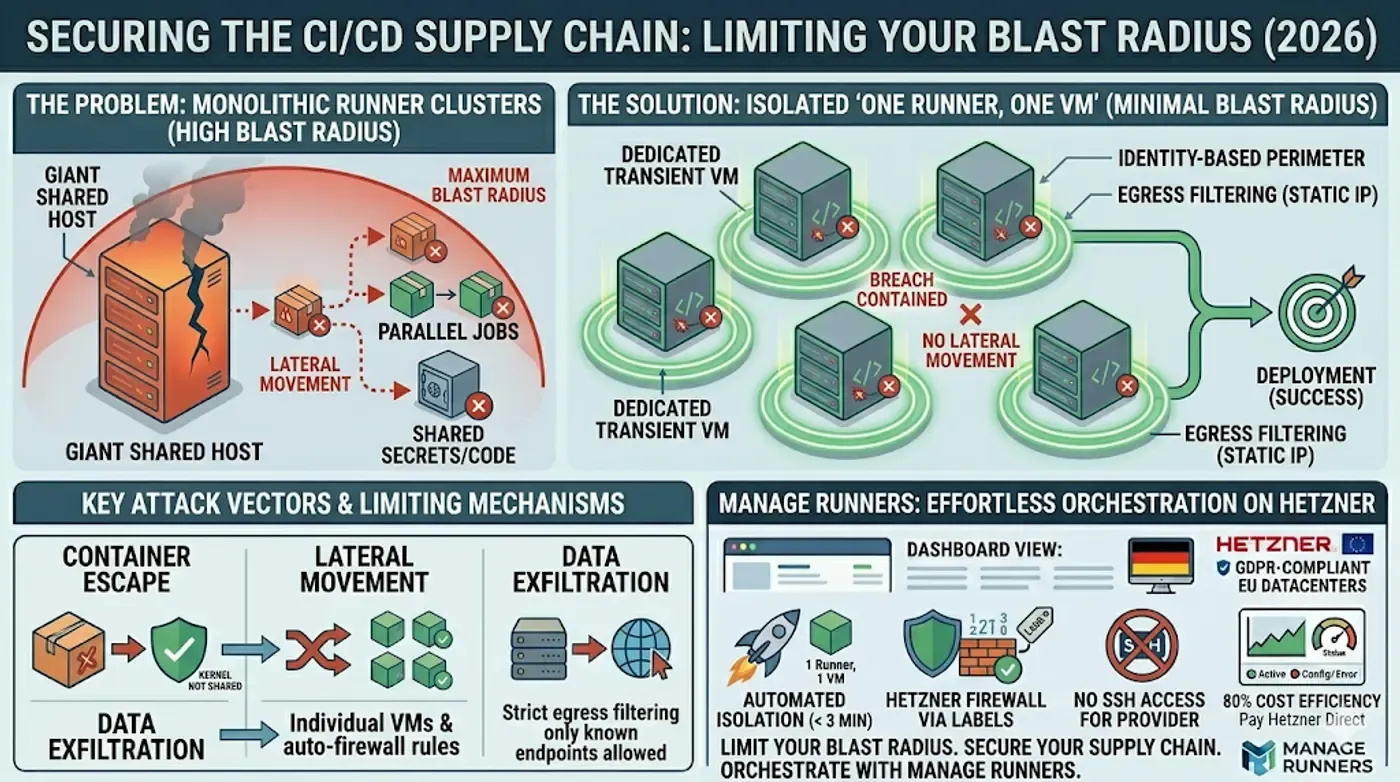
Many teams still operate under the 2010s mindset: "Let's spin up one massive Kubernetes cluster or a giant 128-core VM and run all our CI jobs there." While this feels efficient, it ignores the reality of modern exploitation. In a shared environment, the kernel is a common point of failure. If a malicious dependency triggers a container escape, every other job on that host and potentially the secrets injected into them is exposed.
2. Quantifying the Blast Radius
In cybersecurity, the Blast Radius refers to the maximum potential damage caused by a single security breach. In a monolithic runner setup, the radius is absolute.
If an attacker gains code execution on one runner, they can:
- Perform lateral movement across the internal network.
- Scan the host for Docker sockets or sensitive environment variables from parallel jobs.
- Exfiltrate source code from other repositories being built on the same machine.
By contrast, a "One Runner, One VM" architecture ensures that the Blast Radius is physically limited to a single, transient instance that is destroyed after the job finishes.
3. Strengthening Supply Chain Security
Your build process is only as secure as its weakest dependency. Supply Chain Security isn't just about scanning your package.json; it's about ensuring that if a malicious package does get through, it cannot "phone home" or infect your broader infrastructure.
Hardening this layer requires deterministic identity. When runners are isolated on their own VMs with a Static IP address, you can implement strict egress filtering. You shouldn't allow your build runners to talk to the open internet; they should only communicate with known, whitelisted package registries and your internal deployment targets.
4. The Architecture of Isolation
To achieve a "Zero Trust" build environment in 2026, engineers should adopt the following blueprint:
- Hypervisor-level Isolation: Use dedicated Virtual Machines rather than just containers on a shared host.
- Transient Lifecycles: Provision the VM, run the build, and terminate the instance.
- Network Siloing: Automatically assign firewalls to each runner instance to block all lateral traffic.
# Example: Using Hetzner Labels to auto-apply firewalls for isolation
hetzner-cli server create --name "runner-isolated-01" \
  --label "security-tier=isolated-build" \
  --image "ubuntu-22.04" --type "cax11"
# The firewall is then globally applied to any server with this label.
5. Manage Runners: Effortless Isolation for Modern DevOps
At Manage Runners, we believe that top-tier security shouldn't come at the cost of "toil." Our platform is designed to automate the very isolation patterns that define "Elite" Supply Chain Security.
- One Runner, One VM: We spin up dedicated runners on Hetzner Cloud in under 3 minutes. No shared clusters, no shared kernels.
- Hardened by Default: Automatically assign Hetzner Firewalls via labels directly through our dashboard to restrict your Blast Radius.
- Static IP Identity: Whitelist your build nodes with confidence using dedicated IP addresses for every runner.
- Privacy First: We are GDPR compliant and, crucially, Manage Runners has no SSH access to your VMs. Your code stays in your Hetzner account, behind your own security perimeter.
By leveraging Hetzner’s high-performance EU data centers and our automated orchestration, you can slash your CI/CD costs by up to 80% while reaching a level of security that monolithic clusters simply cannot provide.
6. Conclusion
Putting all your build eggs in one cluster basket is a strategy for disaster. By isolating your runner fleet and narrowing your Blast Radius, you turn your CI/CD from a vulnerability into a stronghold.
Ready to harden your pipeline? [Start your secure CI/CD journey with Manage Runners] and build with total peace of mind on Hetzner Cloud.